 English
 Español
 Français
 Deutsch
 Português
 Italiano
 Русский
 中文(简体)
 日本語
 한국어
 العربية
 हिन्दी
 Nederlands
 Türkçe
 Polski
-vs-translator.png)
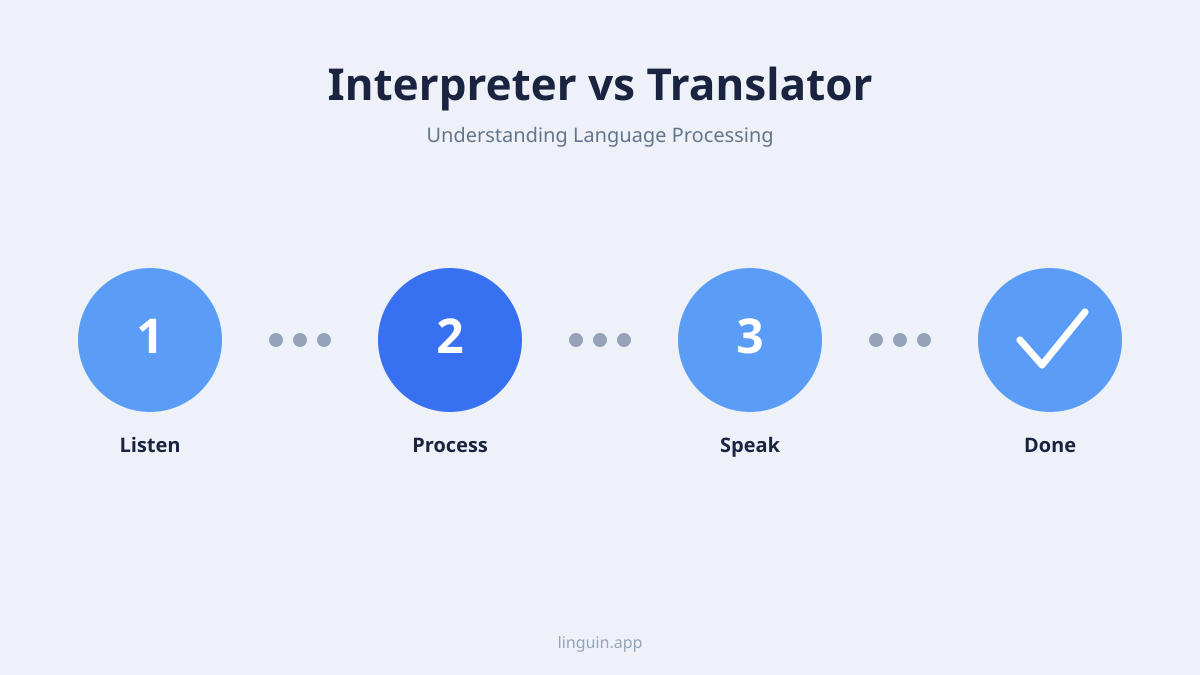
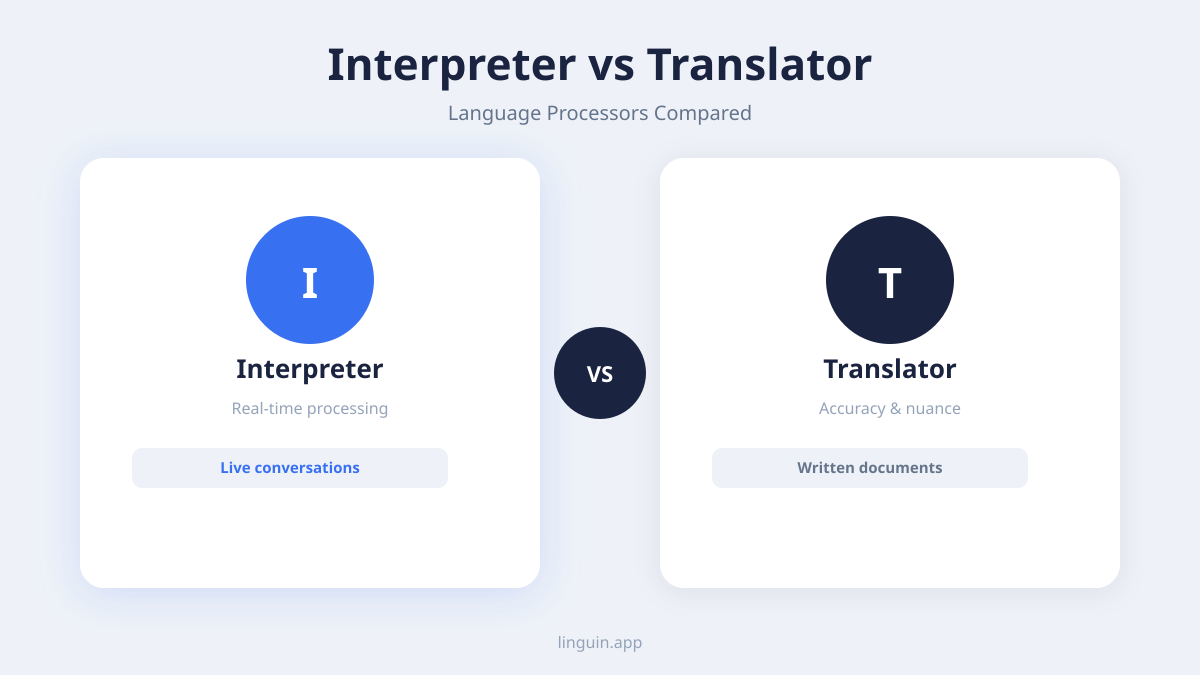
While both interpreters and translators work with languages, they perform distinct roles. An interpreter works with spoken language in real time, while a translator works with written text. This core difference in medium and immediacy shapes their skills, tools, and applications. Understanding the interpreter vs translator distinction helps you choose the right service for your needs, whether you are preparing a legal document or joining an international video call. This guide explains the key differences, use cases, and how modern AI tools are changing the landscape.
Key takeaways
- Interpreters work with spoken language in real-time scenarios like meetings or calls, requiring strong memory and quick thinking.
- Translators work with written text, allowing time for research, editing, and ensuring precise terminology and style.
- The choice between an interpreter, translator, or an AI tool depends entirely on whether your need is for live conversation or documented text.
The fundamental difference: medium and time
The most basic distinction lies in what they work with and when. An interpreter deals with the spoken word. Their work is oral and happens in the moment, facilitating communication between people who speak different languages. A translator deals with the written word. Their work is textual and allows for a delayed process of analysis, research, and revision.
This difference in medium creates a cascade of other differences. Because interpretation is live, an interpreter must process, convert, and deliver speech almost simultaneously. There is no time to consult a dictionary or deliberate over a tricky phrase. The pressure is on accuracy, completeness, and conveying tone in the flow of conversation. Translation, by contrast, is an asynchronous task. A translator receives a source document and has the luxury of time to deeply understand the context, research specialized terms, and craft a polished final version that reads as if it were originally written in the target language.
Think of it this way: interpretation is like a live sports commentator, reacting and describing events as they unfold. Translation is like a film subtitler, who can watch a scene multiple times, choose the perfect words, and ensure the text fits on screen and syncs with the dialogue.
The skills required for each profession diverge from this starting point. An interpreter needs exceptional short-term memory, active listening skills, and the ability to think quickly under pressure. Public speaking prowess and a clear, articulate voice are also important. A translator needs excellent writing skills, meticulous attention to detail, and deep research abilities. They must be a master of grammar, style, and nuance in both the source and target languages.
What does an interpreter do?
Interpreters enable live, cross-lingual dialogue. Their primary goal is to convey the meaning, intent, and often the emotional tone of a speaker from one language to another as the conversation happens. This real-time work happens in several distinct modes.
In simultaneous interpretation, the interpreter listens and speaks at nearly the same time, usually with a slight lag of a few seconds. This is the mode used at large international conferences, United Nations sessions, or live broadcasts. The interpreter works from a soundproof booth, listening through headphones and speaking into a microphone that feeds directly to the audience’s headsets. It demands intense concentration and is considered one of the most cognitively demanding forms of interpretation.
Consecutive interpretation involves the speaker pausing after a complete thought or a few sentences, allowing the interpreter to then render that segment into the other language. The interpreter often takes notes using specialized symbols and shorthand to remember the key points. This mode is common in smaller meetings, legal depositions, medical appointments, or business negotiations. It requires strong note-taking skills and a reliable memory.
Whispered interpretation (chuchotage) is a form of simultaneous interpretation where the interpreter sits or stands next to one or two listeners and whispers the translation directly into their ear. It is used in settings where only a few people need interpretation, and setting up booth equipment is not practical.
Sight translation is a hybrid skill where an interpreter is given a written document and asked to render it orally into another language on the spot. This might happen in a courtroom when a document is introduced as evidence, or in a clinic when a patient needs a form explained.
Common scenarios for interpreters include:
- International business meetings and negotiations.
- Multilingual conferences and live events.
- Courtroom proceedings and attorney-client meetings.
- Hospital visits and medical consultations.
- Parent-teacher conferences in multilingual school districts.
- Live television or streaming broadcasts with international guests.
Say you are a project manager on a video call with a software development team in Poland. You need to discuss sprint goals, clarify requirements, and answer questions in real time. A consecutive interpreter on the call would allow this fluid, interactive discussion to happen without long pauses, ensuring misunderstandings are caught and resolved immediately.
What does a translator do?
Translators convert written text from a source language into a target language. The end product is a new document that is accurate, reads naturally, and is culturally appropriate for its intended audience. Unlike interpretation, translation is not about speed of delivery but about quality of output.
The translation process is methodical. It begins with a thorough analysis of the source text to understand its purpose, audience, tone, and any specialized terminology. The translator then produces a draft, constantly making choices about equivalence. Should this idiom be translated literally, or replaced with a culturally equivalent one? How should this technical term, which may not have a direct counterpart, be rendered? They use glossaries, style guides, translation memory software, and subject-matter research to ensure consistency and accuracy.
After the draft is complete, the crucial step of revision or editing takes place. The translator, or often a separate editor, reviews the translation against the source text to check for omissions, errors, or mistranslations. Finally, proofreading focuses solely on the target text, polishing grammar, spelling, punctuation, and flow to ensure it reads like an original piece of writing.
Translators often specialize in specific fields, developing deep expertise in the relevant jargon and conventions. A legal translator must be precise with contracts and statutes, a medical translator needs accuracy with patient records and research papers, and a technical translator must correctly handle manuals and specifications. Literary translators face the unique challenge of capturing an author’s voice, style, and artistic intent, making their work as much an art as a science.
Common documents for translation include:
- Legal contracts, patents, and certificates.
- Technical manuals, safety data sheets, and engineering specifications.
- Marketing brochures, websites, and advertising copy.
- Academic papers, books, and journal articles.
- Software interfaces, mobile apps, and video game scripts.
- Financial reports and regulatory filings.
For example, if your company is launching a new product in Germany, you need your user manual, marketing website, and compliance labels accurately translated. A skilled technical translator would ensure the instructions are clear and safe, while a marketing translator would adapt your campaign slogans to resonate with a German audience, a process explored in our guide to English to German translation. The final translated documents become permanent assets for your business.
Key skills and tools for each role
The divergence in their work shapes the essential skills and tools for interpreters and translators.
An interpreter’s toolkit is built for speed and oral performance. Their most important tool is their own mind, trained for active listening and short-term memory retention. They develop mnemonic techniques and a specialized note-taking system using symbols, abbreviations, and spatial layout on the page to capture ideas, not just words. For simultaneous interpretation, soundproof booths, high-quality headphones, and microphones are standard professional equipment. In remote settings, reliable video conferencing platforms with clear audio are critical. Unlike translators, interpreters rarely use software during the act of interpretation itself, though they may use glossaries and preparation materials beforehand.
A translator’s toolkit is designed for research, consistency, and writing. The cornerstone of modern translation is Computer-Assisted Translation (CAT) tools. These are not AI translators, but software that aids the human translator. They break text into segments, store previous translations in a translation memory for consistency, and manage terminology databases. Translators rely on bilingual dictionaries, specialized glossaries, style guides, and extensive online research to verify terms and context. They are proficient with word processors and, depending on their specialty, might work with desktop publishing software, subtitling programs, or coding environments for localizing software.
The required personal attributes also differ. An interpreter must have:
- Mental agility and the ability to perform under pressure.
- Excellent public speaking and clear diction.
- Strong interpersonal skills and cultural sensitivity for live interaction.
- Physical and mental stamina to maintain concentration for long periods.
A translator must have:
- Exceptional writing skills and a strong command of grammar and style in the target language.
- Meticulous attention to detail and a perfectionist streak.
- Deep research skills and intellectual curiosity.
- Patience and the ability to work independently for long stretches.
When to use an interpreter vs a translator
Choosing the correct professional is straightforward once you identify the nature of your communication need.
You need an interpreter when:
- The communication is happening live and orally. This includes meetings, conferences, calls, tours, or medical appointments.
- Immediate, two-way dialogue is required. All parties need to speak and be understood in real time.
- The event is ephemeral; there is no permanent written record of the exchange that needs to be crafted (though an interpreter’s work may be transcribed later).
You need a translator when:
- The source material is written text. This includes documents, websites, books, emails, or subtitles.
- The output needs to be a polished, accurate, and permanent written document.
- You have time for a process that includes drafting, editing, and proofreading to ensure the highest quality.
Sometimes, both are needed for a single project. A company might hire a translator to prepare the written speeches and presentations for an international summit, and then hire a team of interpreters to deliver those speeches live in multiple languages during the event itself.
For personal or less formal needs, AI-powered translation apps like Linguin are blurring these lines by offering capabilities for both written text and real-time conversation. You can use it as a translator to understand a foreign language article in your Safari browser with our website translator plugin, or as a virtual interpreter to have a spoken conversation with someone by speaking into your iPhone. Understanding the traditional roles helps you decide when a human professional’s nuance is irreplaceable and when a powerful AI tool can provide immediate, practical assistance, much like the comparisons in Google Translate vs AI translator.
The cost of interpretation and translation services
Pricing structures for human interpreters and translators reflect their different working models. Interpreters typically charge by time, while translators charge by word or project.
Professional interpreters often bill by the hour, half-day, or full-day, with minimums. Rates vary significantly based on language pair (rare languages cost more), specialization (medical or legal interpreting commands higher fees), mode (simultaneous is more expensive than consecutive), and location. For telephonic or video remote interpreting, services often charge per minute. For instance, according to a report from Customer Experience, Day Interpreting charges $1.25 per minute for Spanish and $1.75 per minute for most other languages. The same source notes that Jeenie Connect charges $1.99 per minute for common languages and $4.99 for rare ones on a pay-as-you-go plan, while LanguageLine Personal Interpreter charges $3.95 per minute for audio.
Translators typically charge per source word. Rates depend on the language pair, subject matter complexity, technicality, and required turnaround time. A general marketing text will cost less per word than a highly technical pharmaceutical patent. Translators may also charge by the page or offer a flat project fee for larger jobs. Editing and proofreading services are usually billed at an hourly rate.
Subscription-based AI interpretation services offer a different model. For example, according to Interpreterly, their AI phone interpreter plan starts at $147 per month for 500 minutes on one line. LiveLingo offers a Pro plan with translated phone calls for $19.99 per month for 300 minutes. Some platforms bundle interpretation with other services; according to Microsoft Support, Microsoft Teams includes 20 hours of interpretation per person per month with a Microsoft Copilot license. Other apps, like the Interpreter app, use a credit model; according to their site, it offers a pay-as-you-go plan costing $10 for 22 hours of use, with packs starting at $0.45 per hour.
For written translation, many AI apps like Linguin offer subscription plans that provide unlimited text translation across devices, which can be more cost-effective for high-volume, non-critical personal or business use compared to per-word human translation fees.
How AI is changing interpretation and translation
Artificial intelligence is not replacing human linguists but is creating a new tier of tools that augment their work and serve different needs. For translation, AI models, particularly large language models (LLMs), have dramatically improved the quality of machine translation. They are better at understanding context, idioms, and producing natural-sounding output. This has made AI translation excellent for gisting (getting the main idea of a text), translating large volumes of content quickly, and providing instant translations for users on the go, like in a menu bar translator for Mac. Human translators now often use AI output as a first draft to post-edit, significantly speeding up their workflow while applying their nuanced understanding for final quality, a process detailed in our look at AI translation accuracy.
For interpretation, AI is enabling real-time speech-to-speech translation. Apps can now listen to speech, transcribe it, translate the text, and synthesize speech in the target language in near real-time. This technology powers features like live conversation mode in translation apps and real-time subtitle generation for videos. While it cannot yet match the subtlety, cultural adaptation, and error-handling of a professional human interpreter in high-stakes settings, it is incredibly useful for travel, casual conversations, customer support, and understanding foreign language media.
These AI tools are making basic cross-language communication more accessible and affordable. They act as a bridge for simple, everyday interactions where hiring a human professional would be impractical. However, for situations requiring guaranteed accuracy, deep cultural nuance, specialized knowledge, or high-stakes diplomacy, the expertise of a human interpreter or translator remains essential. The future lies in a hybrid model where AI handles routine, scalable tasks, and humans focus on complex, creative, and critical communications.
Common questions
Can one person be both an interpreter and a translator?
Yes, many language professionals are trained in and practice both disciplines. The core language skills are transferable. However, most develop a preference and specialize in one area because the skill sets and working styles are so different. It is common for a professional to offer both services but market themselves primarily as one or the other based on their strengths and market demand.
Is AI translation as good as human translation?
It depends on the purpose. For informal communication, understanding the gist of a webpage, or translating simple documents, modern AI translation is highly effective and instant. For published materials, legal contracts, marketing copy, or any text where nuance, brand voice, and perfect accuracy are critical, human translation is superior. A human can understand subtle context, cultural references, and creative intent that AI may still miss. The best practice is often a combination: AI for speed and scale, with human oversight for quality.
What is the difference between translation and localization?
Translation is the process of converting text from one language to another. Localization goes further by adapting the content to the cultural, functional, and legal context of the target market. This includes changing date formats, currencies, measurement units, colors, images, and even modifying content to respect local sensitivities. Translation is a key part of localization, but localization is a broader, more holistic process. For example, translating a software interface is a step; localizing it ensures all icons, examples, and user flows make sense for that region.
Choosing the right solution for your needs
The choice between an interpreter, a translator, or an AI tool hinges on a simple question: is your need for live speech or for written text? For real-time conversations in meetings, appointments, or calls, you are in the realm of interpretation. For documents, websites, or books, you need translation. For high-stakes, formal, or legally binding situations in either category, investing in a qualified human professional is the prudent choice. For everyday understanding, travel, quick tasks, or scaling communication affordably, modern AI translation tools offer remarkable capability.
Tools like Linguin are designed to handle both written translation and real-time conversational needs across over 100 languages, giving you flexibility. You can use it to translate a PDF on your Mac or have a spoken conversation using the voice translator app on your iPhone. By understanding the traditional roles, you can make informed decisions about when to leverage powerful, immediate AI assistance and when to seek out specialized human expertise. The goal is always clear communication, and now you have more options than ever to achieve it.
Ready to experience AI-powered translation and interpretation for your daily tasks? You can download Linguin for Mac and try it across all your devices.