 English
  Español
  Français
  Deutsch
  Português
  Italiano
  Русский
  中文(简体)
  日本語
日本語  한국어
한국어  العربية
  हिन्दी
  Nederlands
  Türkçe
  Polski
Accurate translation is the cornerstone of any successful international real estate transaction. Whether you’re a buyer, seller, agent, or investor, understanding every clause and term in a property document is non-negotiable. Misunderstanding a single sentence in a lease, purchase agreement, or title deed can lead to costly legal disputes, financial loss, and significant delays. This guide is for anyone navigating the complex world of cross-border property dealings. You will learn the critical importance of precise document translation, the specific types of documents that require expert handling, and how modern AI tools provide a reliable, efficient solution for overcoming language barriers in real estate.
Key takeaways
- Real estate documents contain legally binding terminology where a single mistranslation can invalidate a clause or create liability.
- AI-powered translation tools now offer the context-aware precision needed for technical fields, moving beyond simple word-for-word conversion.
- A streamlined translation workflow that integrates with your existing tools saves time and reduces errors during due diligence and closing.
Why accurate real estate document translation is critical
In real estate, a document is not just a piece of paper, it is a binding contract that defines ownership, responsibility, and financial commitment. The stakes for perfect comprehension are exceptionally high. Unlike translating a casual email or a website, real estate translation demands absolute fidelity to the original text’s legal intent. A minor error in translating a term like “easement,” “encumbrance,” or “force majeure” can completely alter the parties’ obligations.
The consequences of poor translation are severe. For a buyer, it could mean unknowingly agreeing to costly repair responsibilities or missing a critical disclosure about property defects. For a landlord or tenant, a mistranslated lease clause about subletting or maintenance could lead to breaches and eviction proceedings. In investment scenarios, inaccurate financial statements or prospectuses can misrepresent asset value, leading to poor decisions and lost capital. The goal of translation in this context is not literary flair, but perfect, unambiguous technical accuracy that preserves the document’s legal power in the target language.
This precision requires more than a basic dictionary. It requires an understanding of how legal concepts function in both the source and target legal systems. For instance, a “condominium” in one country may not have the exact same legal structure as an “apartment ownership” model in another. A good translation must bridge that conceptual gap, ensuring all parties have the same understanding of their rights and duties.
Types of real estate documents that need translation
The real estate lifecycle generates a wide array of documents, each with its own linguistic challenges and requirements for precision. Recognizing which documents need professional translation is the first step in managing any international transaction.
Purchase and sale agreements. This is the core contract governing a property transaction. It must be translated with exacting care, as it includes the sale price, payment terms, property description, contingencies (like financing or inspection), and closing details. Any ambiguity in the translated version can derail the deal or cause post-closing disputes.
Leases and rental agreements. Whether for commercial or residential property, leases define the landlord-tenant relationship. Key sections that require flawless translation include the duration of the lease, rent amount and escalation clauses, security deposit terms, maintenance responsibilities, permitted use of the property, and termination conditions.
Deeds and titles. These documents prove ownership. Translating a deed involves accurately conveying the legal description of the property, the names of the grantor and grantee, and any covenants or restrictions that run with the land. A title search may also reveal documents like liens or judgments that must be understood in the buyer’s language.
Due diligence materials. This category is broad and includes environmental reports, zoning certificates, building inspection reports, financial statements for income properties, and homeowners’ association (HOA) bylaws. Translating these materials allows investors and buyers to make fully informed decisions.
Mortgage and loan documents. For cross-border financing, loan agreements, promissory notes, and mortgage deeds must be clear to all signatories. The terms regarding interest rates, repayment schedules, default consequences, and collateral are legally complex and cannot be left to chance.
Disclosure forms. Property condition disclosures, lead paint warnings, and other mandatory forms are legally required in many jurisdictions. Their accurate translation ensures compliance and protects both buyers and sellers from future claims of nondisclosure.
The evolution from human to AI-powered translation
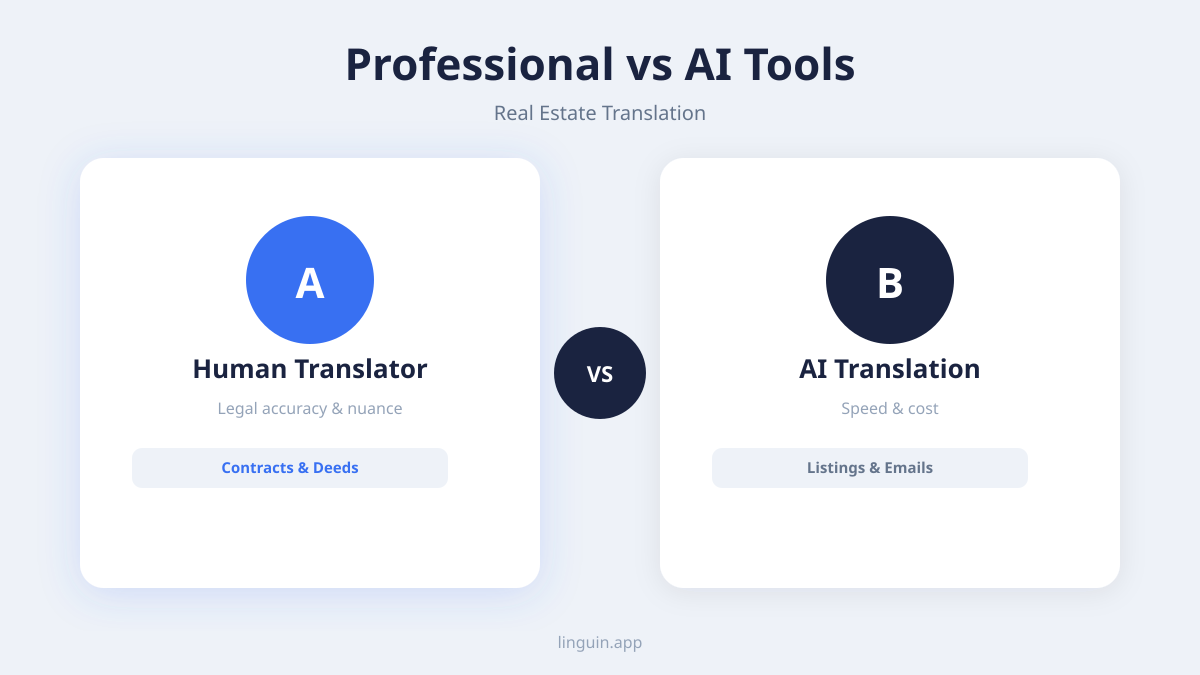
For decades, the only option for translating sensitive documents was to hire a professional human translator, often one with a specialty in legal or real estate terminology. This process is reliable but can be slow, expensive, and difficult to scale for urgent or high-volume needs. The advent of AI-powered translation has introduced a powerful complementary tool that addresses these limitations.
Early machine translation tools operated on simple statistical models or direct phrase substitution, making them ill-suited for technical documents. They often produced awkward, literal translations that missed nuance and context. Modern AI translation, powered by large language models (LLMs), represents a significant leap forward. These systems are trained on vast corpora of text, including legal and technical documents, allowing them to understand context, idiom, and domain-specific jargon.
The core advantage of context-aware translation is that the AI considers the entire sentence, paragraph, or even document to determine the most accurate meaning of a word. For example, the word “lease” can be a noun or a verb, and “title” can refer to ownership or a name. A context-aware system will correctly interpret these based on surrounding text. This capability is crucial for real estate, where the same word can have different legal meanings. You can explore the principles behind this technology in our article on context-aware translation.
This evolution does not eliminate the need for human expertise. Instead, it creates a more efficient workflow. AI can handle the initial heavy lifting of translating lengthy documents quickly, preserving formatting for PDFs and other file types. A human expert can then review the output for ultimate legal precision, focusing their effort on nuance rather than manual translation. This hybrid approach, combining AI speed with human oversight, offers an optimal balance of accuracy, cost, and turnaround time for real estate professionals.
Key features to look for in a translation tool
Choosing the right tool to translate real estate documents is a decision that impacts the security and success of your transactions. Not all translation apps are created equal, especially for handling sensitive legal material. Here are the essential features to prioritize.
Accuracy and context-awareness. As discussed, this is paramount. The tool must demonstrate a strong understanding of technical and legal terminology. Look for solutions that specifically mention domain adaptation or specialized models for professional use, rather than general-purpose chat translation.
Data security and privacy. Real estate documents contain highly confidential information: financial details, personal identities, and property addresses. The translation tool must have a clear and robust privacy policy. Ideally, it should offer offline translation capabilities or guaranteed end-to-end encryption so that your data is not stored or mined on external servers. For more on secure translation options, see our guide to the best offline translator app.
Format preservation. A translated document that loses its original formatting is difficult to use. The best tools can handle complex file types like PDFs, Microsoft Word documents, and PowerPoint presentations, keeping the layout, tables, fonts, and structure intact. This saves immense time compared to copying and pasting text between applications.
Integration with your workflow. Efficiency is key. The tool should fit seamlessly into how you work. This might mean being a native AI translator for Mac with system-wide integration, a Chrome extension for translating web-based portals and emails, or a mobile app for on-the-go review during property visits. The ability to quickly translate text within any application without switching windows is a major productivity boost.
Support for 100+ languages. Real estate is a global market. Your tool should cover not only major languages like Spanish, Mandarin, and Arabic but also less common ones that might be relevant to specific markets or clients. Consistent quality across this wide range is a sign of a mature AI system.
User-friendly interface. Even powerful tools are useless if they are confusing. A clean, intuitive interface that allows you to translate documents with just a few clicks or drag-and-drop actions ensures that the technology aids your process rather than complicating it.
Building a seamless translation workflow
Having the right tool is only part of the solution. Integrating translation into a repeatable, error-proof workflow is what turns a capability into a competitive advantage. Here is a practical framework for handling real estate document translation.
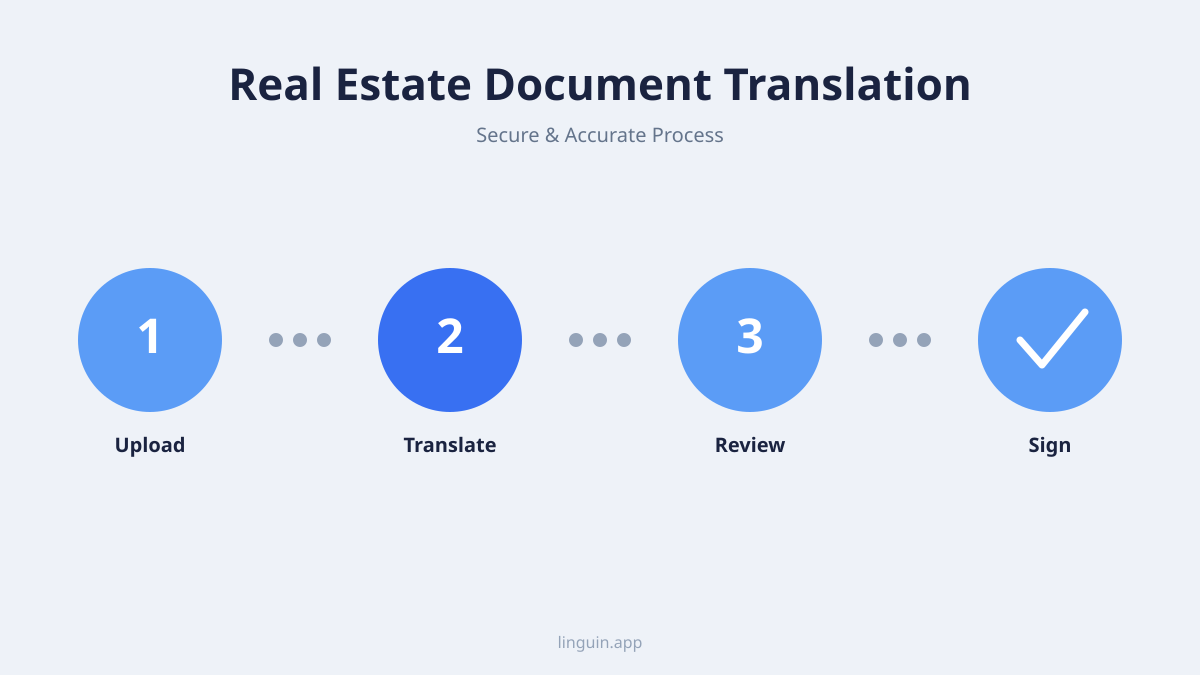
Step 1: Document identification and prioritization. At the start of a transaction, identify all documents that require translation. Categorize them by type (contract, due diligence, disclosure) and priority. Critical path documents like the purchase agreement should be translated first, while supplementary reports can follow.
Scenario: You are a U.S.-based investor reviewing a portfolio of commercial properties in Germany. You receive a Kaufvertrag (purchase contract), a Grundbuchauszug (land register excerpt), and three years of Gewinn- und Verlustrechnungen (profit and loss statements). You prioritize the contract and land register for immediate translation to assess deal structure and title, while scheduling the financials for translation during deeper due diligence.
Step 2: Initial AI translation. Use your chosen AI translation tool to perform the first-pass translation. For bulk documents, use batch processing features. For a PDF purchase agreement, leverage the tool’s format preservation to get a translated document that mirrors the original’s layout, making it easy to cross-reference.
Step 3: Human review and legal verification. This step is non-optional. A qualified professional-either a bilingual real estate attorney or a certified translator specializing in legal documents-must review the AI-generated translation. They will check for technical accuracy, ensure compliance with local legal terminology, and confirm that no subtle meaning has been lost. This review is your quality assurance checkpoint.
Step 4: Version control and distribution. Maintain clear version history for both the original and translated documents. Store them together in your secure project management or data room system. When distributing the translated version to clients or partners who do not speak the source language, always provide a disclaimer noting that the translation is for convenience and that the original language document remains the legally controlling version.
Step 5: Integration into communications. Use translation browser extensions or in-app translation to handle ongoing communication. For instance, when emailing with a notary in Italy or reading a Spanish-language property listing website, you can get instant, context-aware translations without leaving your browser. This keeps the entire communication chain understandable. Compare the top options in our Chrome translator extension comparison.
Common pitfalls and how to avoid them
Even with the best intentions and tools, certain common mistakes can compromise the integrity of translated real estate documents. Awareness of these pitfalls is the best defense.
Relying solely on free, general-purpose translators. Tools designed for translating menus or travel phrases are not built for the complexity of a property deed. They lack the necessary context and often have poor data privacy practices. Using them for confidential documents is a significant risk.
Neglecting country-specific legal terminology. Real estate law is intensely local. A “escrow” process in the United States is different from a “deposit held in trust” in the UK, though they serve similar functions. Ensure your translation process, whether AI or human, accounts for these jurisdictional differences. The translation should sound like a native legal document from the target country.
Ignoring formatting and visual elements. A translated document that scrambles numbered clauses, misaligns signature blocks, or mangles tables is practically unusable and looks unprofessional. Always verify that the final output maintains the original’s clean, official presentation.
Scenario: A property survey diagram is embedded in a PDF. A poor translation tool might extract only the text, leaving the image untranslated or placing translated labels incorrectly over the diagram. A capable tool will handle text within images or allow you to easily annotate the translated terms onto the visual.
Skipping the final review for “good enough” translations. The pressure of a fast-moving transaction can tempt parties to skip the professional review step. This is a dangerous gamble. The time and cost of a review are minimal compared to the expense of litigating a misunderstood clause years later.
Failing to disclose the use of AI translation. Transparency is important. When providing a translated document to another party, it is good practice to state that it was produced with the assistance of AI translation and reviewed for accuracy. This manages expectations and demonstrates due diligence.
Frequently asked questions
Can AI translation handle complex legal terms in real estate?
Yes, modern AI translation models are specifically trained on diverse text corpora, including legal and technical documents. They excel at context-aware translation, which allows them to accurately interpret complex terms like “lien,” “encumbrance,” or “quiet enjoyment” based on how they are used in a sentence and within the document. For the highest assurance, the output should always be verified by a professional familiar with the relevant real estate law.
Is it safe to upload confidential real estate documents to a translation app?
Safety depends entirely on the app’s privacy and security policies. Before using any tool, review its data handling practices. Look for services that offer end-to-end encryption, clear policies stating that your data is not used for training or stored long-term, and preferably, offline translation modes. For sensitive documents, using a reputable tool with strong security credentials is essential. Learn more about secure options in our review of the best document translation service.
How does AI translation compare to a human legal translator in cost and speed?
AI translation offers a significant advantage in speed, translating lengthy documents in seconds or minutes, compared to days for a human. In cost, AI is typically far less expensive, often available through a subscription or per-document fee that is a fraction of a human translator’s rate. The most effective approach is a hybrid model: use AI for the fast, initial draft to capture the bulk of the content, then invest in a human expert to review and polish the critical legal sections. This balances speed, cost, and ultimate accuracy.
What is the best format for translating real estate documents?
PDF is the most common and often the best format, as it preserves the original layout, signatures, and seals. A quality translation tool should be able to process PDFs while maintaining this formatting. For collaborative editing, a Word document (.docx) can also be suitable, as it allows tracked changes during the human review phase. The key is to choose a tool that supports your required format without corrupting the file’s structure.
Implementing precise translation in your practice
The ability to accurately translate real estate documents is no longer a luxury reserved for large international firms with big budgets. It is an accessible necessity for anyone participating in the global property market. The combination of advanced, context-aware AI and strategic human review creates a workflow that is both highly reliable and operationally efficient. This approach minimizes risk, accelerates transaction timelines, and ensures all parties have clear, mutual understanding.
The most important points are to never compromise on accuracy for critical documents, always prioritize tools with strong security, and establish a consistent review process. The next step is straightforward: evaluate your current needs. Identify one upcoming transaction or document type where language is a barrier and test a modern AI translation tool that offers the features outlined here. See how it integrates into your daily work on your Mac, phone, or browser.
Linguin is built to meet these specific demands, providing secure, context-aware translation across devices to help you navigate international real estate with confidence. By adopting these practices, you turn a potential obstacle into a smooth pathway for growth and success in new markets.