 English
  Español
  Français
  Deutsch
  Português
  Italiano
  Русский
  中文(简体)
  日本語
日本語  한국어
한국어  العربية
  हिन्दी
  Nederlands
  Türkçe
  Polski
Organizing a successful event for a global audience hinges on clear, consistent communication across every language barrier. Multilingual event planning translation is the strategic application of translation technology to coordinate every detail, from initial invitations to post-event follow-ups, ensuring every participant feels included and informed. This guide is for event planners, corporate coordinators, and community organizers who manage international conferences, hybrid meetings, or multicultural local gatherings. You will learn how to integrate AI translation tools into your workflow to overcome linguistic obstacles, enhance attendee experience, and execute events with professional precision.
Key takeaways
- AI translation enables real-time communication during live event sessions, breaking down language silos between speakers and attendees.
- Consistent translation of event materials like agendas, signage, and emails ensures all participants receive the same core information.
- Translating attendee feedback and support queries provides organizers with a complete, unified view of the event’s success and areas for improvement.
- Using a single AI translation platform across all devices and communication channels maintains terminology consistency and reduces planning overhead.
The challenges of multilingual event coordination
Coordinating an event in multiple languages introduces a layer of complexity that goes beyond basic logistics. The core challenge is maintaining a single, coherent event experience that feels equally accessible and engaging for everyone, regardless of their native language. Without a structured approach to translation, information becomes fragmented. Key announcements might be understood by only a portion of the audience, logistical details can be misinterpreted, and the sense of a unified community can be lost.
This fragmentation occurs across several critical areas. Pre-event communications, such as save-the-dates, invitations, and registration instructions, must be perfectly clear to ensure proper attendance and preparation. During the event, real-time elements like speaker presentations, Q&A sessions, and networking conversations require immediate translation to be meaningful. Post-event follow-up, including surveys, thank-you notes, and shared resources, needs to be translated to gather accurate feedback and maintain relationships. Each phase relies on timely and accurate language transfer.
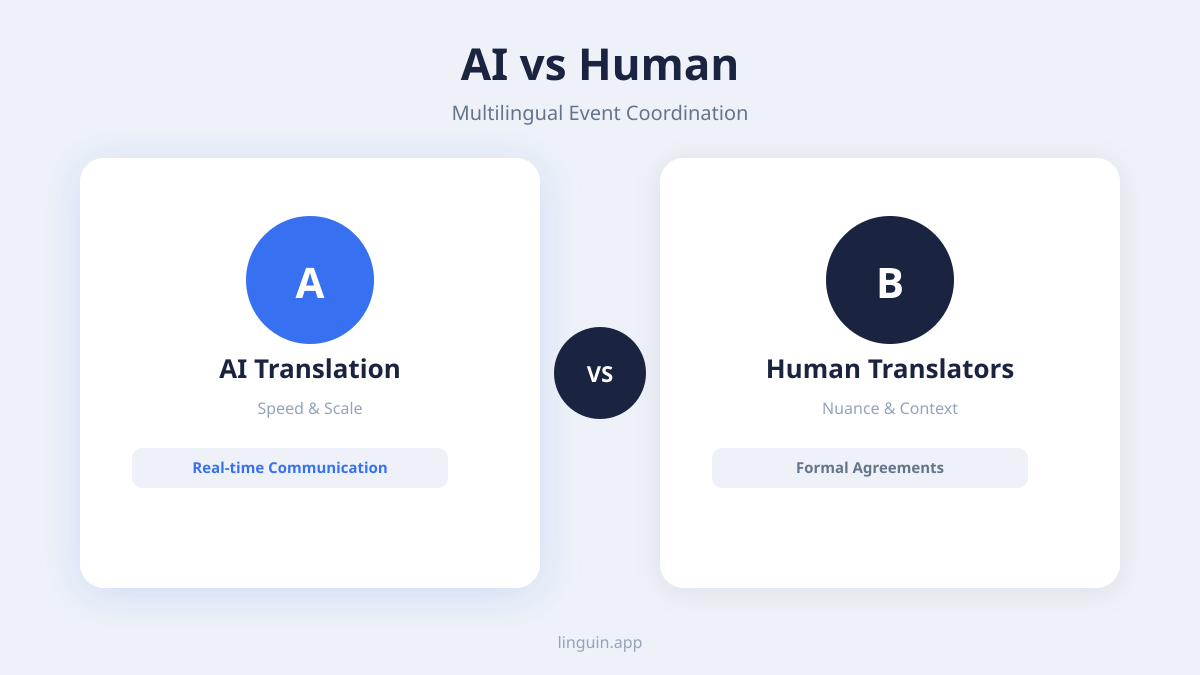
The traditional method of hiring human translators for every interaction is often impractical due to cost, scalability, and speed. It is difficult to have a translator present for every spontaneous conversation between attendees or for reviewing the hundreds of support emails that might come in. This is where a strategic approach using AI translation becomes essential. It provides a scalable, always-available layer of language support that complements human expertise where it matters most, such as for high-stakes legal contracts or polished marketing copy.
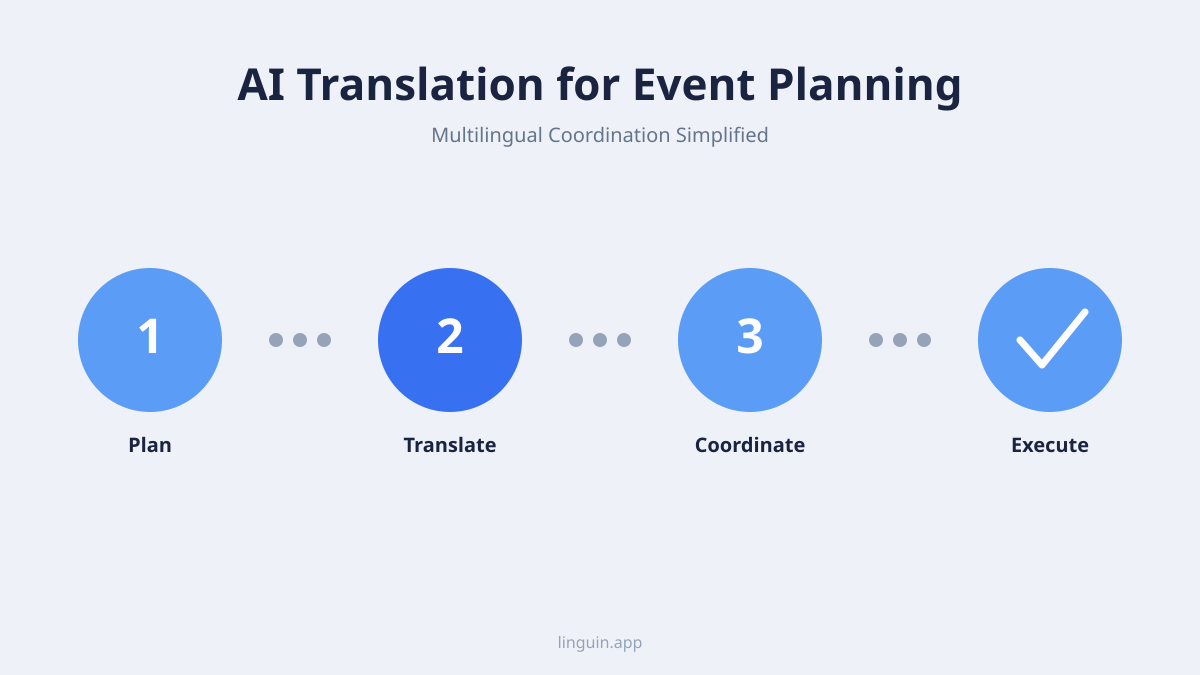
Pre-event planning: building a multilingual foundation
The success of a multilingual event is determined long before the doors open. This phase is about building a solid, linguistically inclusive foundation. Every piece of information you create must be designed for translation from the start. This involves centralizing your core messaging and key terminology. Create a master glossary of event-specific terms, speaker names, session titles, and venue locations. Ensuring these terms are translated consistently across all platforms and materials prevents confusion and presents a professional, organized front to your global attendees.
Your pre-event communication suite is the first touchpoint. These documents set expectations and require absolute clarity.
- Invitations and registration pages: Translate the entire user journey, from the promotional landing page to the checkout confirmation. Ambiguity here can lead to low turnout or incorrect registrations.
- Agendas and programs: A translated schedule is non-negotiable. Attendees need to plan their time, and speakers need to know when they are presenting. Include session descriptions, speaker bios, and location maps.
- Logistical emails: Travel instructions, visa support letters, accommodation details, and dietary preference forms must be accurately translated. Misunderstanding here can cause major attendee distress.
- Sponsor and exhibitor kits: If you have partners, their success depends on understanding booth specifications, branding guidelines, and attendee demographics in their own language.
For internal coordination, your planning team likely uses project management tools like Asana, Trello, or Jira. Integrating an AI translation tool like Linguin directly into your browser via its Chrome or Safari extension allows team members to instantly translate task updates, comments, and shared documents. Say you’re coordinating with a local vendor in Spain; you can quickly translate their proposal or query within your project management interface, keeping the workflow seamless and avoiding constant context-switching to a separate translation app. This seamless integration is a cornerstone of efficient multilingual project management.
Real-time translation for live event execution
The live event is where planning meets reality, and the need for real-time multilingual communication peaks. AI translation shines in this dynamic environment by providing instant language support across various interaction points. The goal is to make language barriers invisible, allowing content and connection to flow freely.
For presentations and keynotes, speech-to-text translation is invaluable. An AI tool can transcribe a speaker’s words and translate them into subtitles displayed on screens or within a mobile app. This allows attendees to follow along in their preferred language without the delay and cost of a human interpreter for every session. Similarly, during panel discussions or Q&A sessions, attendees can submit questions in their native language via an app or Slido, which are then instantly translated for the moderator and panelists.
Networking and informal conversations are often the most valuable part of an event. Here, conversation mode features in translation apps facilitate face-to-face dialogue. Two attendees can speak into a shared device, with the app translating each phrase audibly or displaying it on screen, creating a natural back-and-forth. This empowers spontaneous connections that would otherwise be impossible. Furthermore, for hybrid events, real-time translation of chat messages in platforms like Zoom or Microsoft Teams ensures remote international participants are fully integrated into the discussion.
On-site support is another critical area. Information desk staff, equipped with a translation app, can answer complex questions about session changes, venue facilities, or local transportation from any attendee. This immediate resolution prevents frustration and improves the overall attendee experience. For a deeper understanding of how AI handles the nuances of live dialogue, you can explore our guide on AI translation accuracy in real-time contexts.
Translating event materials and digital content
Beyond spoken words, an event is defined by its materials and digital footprint. Consistent translation of all visual and textual content reinforces your message and ensures no attendee is left deciphering unfamiliar signs or documents. This category includes both physical items and digital assets.
Physical on-site materials require careful planning, as they are often printed in advance.
- Signage and wayfinding: Directional signs, room names, and informational placards must be translated. Clear multilingual signage is a fundamental courtesy that guides attendees smoothly through the venue.
- Printed programs and handouts: Any supplementary materials given to attendees, like workbooks, case studies, or sponsor leaflets, should be available in key languages.
- Name badges and table tents: Including attendee names and affiliations in their native script shows respect and aids in networking.
Your digital content extends the event’s reach and utility. A multilingual event website or mobile app is central to this. All static pages, news updates, and speaker profiles should be translated. For dynamic content like blog posts announcing sessions or recapping event highlights, AI translation can provide a fast first draft that a human can then polish for stylistic flair.
Social media plays a huge role in modern event engagement. Live-tweeting key quotes, posting photos on Instagram, or sharing updates on LinkedIn should consider a global audience. Using an AI translation tool, you can quickly adapt captions and posts into multiple languages to engage your international followers. Managing this efficiently is key to multilingual social media management. Furthermore, translating slide decks, whitepapers, or video recordings post-event makes your content library accessible to a wider audience, maximizing the long-term return on your event investment.
Post-event follow-up and analysis
The work of a multilingual event planner continues after the final session ends. This phase is about cementing relationships, measuring success, and gathering insights for future improvements-all of which require inclusive communication. Translating post-event communications ensures you collect feedback from your entire audience, not just those who speak the primary event language.
The most critical tool is the attendee survey. To gain an accurate picture of satisfaction, surveys must be translated. This includes not just the questions but also the answer choices. AI translation allows you to deploy identical surveys in multiple languages simultaneously, consolidating results into a single dataset for analysis. This provides a holistic view of what worked and what didn’t across all demographics. Similarly, thank-you emails to attendees, speakers, sponsors, and volunteers should be personalized and sent in the recipient’s language, showing appreciation for their specific contribution.
Analyzing feedback and social media mentions in multiple languages is another crucial step. An AI translation tool can help you process qualitative data from open-ended survey responses, tweets, or forum posts in various languages. This allows you to identify common themes, specific praises, or recurring complaints that you might miss if you only analyze English-language feedback. For instance, you might discover that logistical instructions were clear in Spanish but confusing in Japanese, providing a direct insight for future planning.
Finally, translating post-event reports and summaries for stakeholders is essential. Whether for internal management or for sharing with international sponsors, a translated report ensures everyone understands the event’s outcomes, key metrics, and attendee sentiments. This transparent communication builds trust and lays the groundwork for support for future multilingual initiatives. The process of refining communication based on nuanced feedback ties into the broader challenge of capturing cultural context in translated materials.
Integrating AI translation into your event tech stack
For AI translation to be effective, it must work fluidly with the other tools you already use. The ideal translation solution acts as an integrated layer, not a disruptive standalone app. This means choosing a platform that is accessible across the devices and software that define your event planning workflow.
The first consideration is cross-platform availability. Your core planning team might use macOS desktops, while on-site staff use iOS devices, and you or attendees might need to translate text directly within a web browser. A tool like Linguin, available as a dedicated Mac application, an iOS app, and a browser extension, ensures everyone has access to the same powerful translation engine in their natural working environment. This eliminates compatibility issues and training overhead for different systems.
Next, evaluate integration points. The most common scenario is translating text within web-based tools. A browser extension can instantly translate text in your event registration platform (like Eventbrite), your email client (like Gmail), your project management tool, and even within the backend of your event website CMS. This allows you to communicate and manage tasks without leaving the application. For content creation, some tools offer direct integrations with word processors or design software, helping you translate copy for brochures or websites more efficiently.
Security and data handling are paramount, especially when translating sensitive information like attendee lists, contract details, or feedback. Ensure your chosen translation provider has a clear privacy policy regarding data processing. For highly sensitive documents, you may still opt for a human translator, but for the vast majority of operational communications, a reputable AI tool provides a secure and efficient solution. Understanding the technical capabilities behind these tools can be found in our overview of modern AI language translation technology.
Building a culturally inclusive event experience
Translation is about more than converting words; it is about conveying meaning in a way that is respectful and relevant to the cultural context of your attendees. Cultural intelligence must guide your multilingual event planning to avoid misunderstandings and foster genuine inclusion. AI translation tools are becoming increasingly adept at handling cultural nuances, but a planner’s oversight is still vital.
Consider scheduling and timing. Being aware of major holidays, time zones, and typical working hours in your attendees’ regions when planning session times or sending communications is a basic form of respect. Content itself must be vetted for cultural appropriateness. Imagery, colors, metaphors, and humor do not always translate directly. A joke that works in one culture may fall flat or even offend in another. While AI can help flag potential issues, a review by someone familiar with the target culture is advisable.
Localization of examples and case studies can make content more engaging. If a speaker uses a business example, an AI tool could help adapt it to reference a company or scenario more familiar to a specific regional audience. Furthermore, providing options for dietary requirements, prayer rooms, or other culturally specific needs, and communicating these options clearly in translated materials, shows a deep level of attendee care. The challenge of translating concepts that lack direct equivalents is explored in our article on untranslatable words and concepts.
Ultimately, the goal is to create an environment where every attendee feels seen and valued. This means ensuring that speaker line-ups are diverse, that content is accessible, and that communication is clear in their language. Proactively using translation technology to address these points moves your event from being merely multilingual to being truly globally inclusive, which enhances its reputation and impact.
Frequently asked questions
How accurate is AI translation for complex event terminology?
Modern AI translation models are highly accurate for standard business and event-related language, including technical jargon from specific industries. Their accuracy stems from training on vast datasets of professional texts. For the most consistent results, you can train the system on your own glossary of event-specific terms, speaker names, and branded phrases. For critical, high-visibility content like keynote speeches or legal contracts, a human review step is recommended to polish the AI’s output and ensure perfect nuance.
Can AI translation handle live, real-time conversations at a networking event?
Yes, many AI translation apps offer a conversation or dialogue mode designed for this exact purpose. Two people can speak into a single device, and the app will translate each phrase audibly and/or display it on screen, facilitating a natural back-and-forth. The speed and quality are sufficient for meaningful social and professional exchanges. For large, noisy rooms, using devices with good microphone quality or connecting to a dedicated translation receiver can improve the experience.
What is the best way to translate slide presentations for an international audience?
A multi-layered approach works best. First, use an AI translation tool to get a draft translation of your slide notes and text. Then, adapt the design: use clear, simple visuals that transcend language, and avoid overcrowding slides with text. For the live event, consider using real-time subtitle generation where the speaker’s words are transcribed and translated onto a screen. After the event, you can use AI to create translated versions of the slide deck PDFs for distribution, ensuring the text is properly formatted.
How do I manage translation for an event with more than 10 languages?
Focus on your primary attendee languages, often determined by registration data. Use AI translation to cover the bulk of communications for these languages due to its scalability. For very niche languages with few attendees, you might provide key information (agenda, logistics) in those languages via AI, while relying on English as a common fallback for detailed interactions. Centralizing all translation through one platform like Linguin helps manage this complexity by keeping the process consistent and trackable across all languages.
Is attendee data safe when using an AI translation tool?
Reputable AI translation providers prioritize data security. They often use encryption for data in transit and may offer policies where text is not stored permanently or used to train public models. For event planning, it is important to review the provider’s privacy policy, specifically regarding data retention and usage. For translating highly sensitive data like unreddened contracts or personal identification documents, consulting with a human translation service that offers strict confidentiality agreements may be the prudent choice.
Streamlining your next global event
Multilingual event planning translation is no longer a luxury but a standard requirement for engaging a global audience. The core advantage of integrating AI translation is its ability to provide scalable, instant language support across the entire event lifecycle, from initial invitations to post-event surveys. This technology empowers you to ensure consistent messaging, foster inclusive live interactions, and gather comprehensive feedback, all while managing costs and complexity.
Events with French-speaking guests often need spoken translation on the spot, and our guide on how to translate French audio to English covers doing that from a recording or in real time.
The most effective next step is to integrate translation into your planning from the very beginning. Choose a versatile translation tool that fits seamlessly into your existing tech stack-whether you are drafting emails on your Mac, checking updates on your iPhone, or managing registrations in a web browser. By making translation a natural part of your workflow, you remove friction and focus on what truly matters: creating a memorable and inclusive experience for every single attendee, no matter what language they speak.
-vs-translator.png)