
 English
 Español
 Français
 Deutsch
 Português
 Italiano
 Русский
 中文(简体)
 日本語
 한국어
 العربية
 हिन्दी
 Nederlands
 Türkçe
 Polski
A notarized translation is a translated document accompanied by a notary public’s official seal. This process verifies the identity of the person signing a certification statement, adding a formal, legal layer of authentication. If you are submitting documents for immigration, academic applications, or international business contracts, you may encounter a request for a notarized translation. This requirement exists to prevent fraud and ensure the legitimacy of translated materials in official settings. This guide will explain what a notarized translation is, when it is necessary, how it differs from a certified translation, and the steps to obtain one correctly.
Key takeaways
- A certified translation includes a translator’s statement of accuracy, while notarization only confirms the identity of the person signing that certificate.
- For USCIS immigration forms, a certified translation is required, but notarization is not mandated by USCIS itself.
- According to Bluente Blog, certified translation services in 2026 are typically priced between $20 to $60 per page.
- Notarized translations are commonly required for documents used with foreign governments, certain academic institutions, and some international legal agreements.
Understanding notarized and certified translations
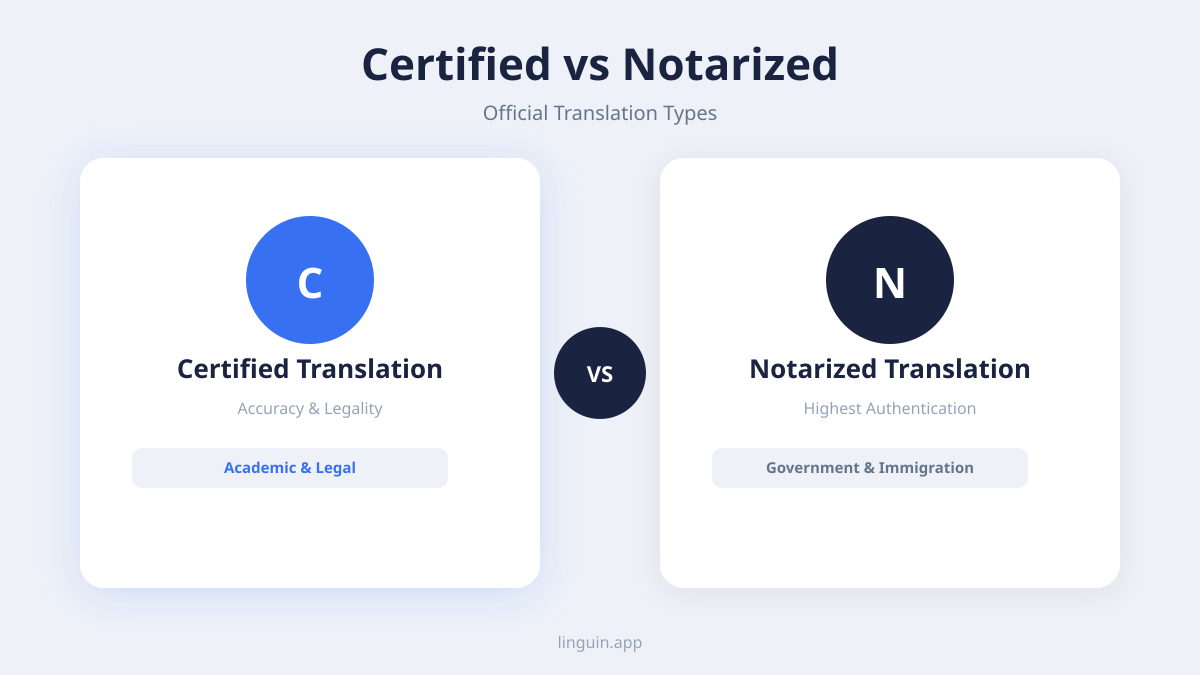
The terms “certified translation” and “notarized translation” are often used together, but they refer to two distinct steps in the authentication process. Understanding this difference is the first step to ensuring your documents are prepared correctly for the requesting authority.
A certified translation is a translation that comes with a signed statement from the translator or translation company. This certificate attests that the translation is a complete and accurate representation of the original source document. The certifier states their qualifications, such as language proficiency and subject-matter expertise, and takes responsibility for the work. This is the core requirement for most official purposes, establishing the translation’s reliability.
Notarization adds another layer. A notarized translation involves a notary public. The notary does not verify the translation’s accuracy or the translator’s skills. Instead, the notary confirms the identity of the person who is signing the translator’s certificate of accuracy. The translator appears before the notary, provides valid identification, and signs the certificate in the notary’s presence. The notary then stamps and signs the document, creating a notarized affidavit. This process legally binds the translator to their statement under penalty of perjury.
A certified translation is a signed statement from the translator attesting to the accuracy of the translation, while notarization only confirms the identity of the person signing the certificate.
The need for one or both depends entirely on the requesting institution. Some entities, like U.S. Citizenship and Immigration Services (USCIS), explicitly require a certified translation but do not require it to be notarized. Others, particularly foreign embassies, consulates, or certain international courts, may insist on the notarization step to formalize the certification for use in their legal system.
When is a notarized translation required?
You will typically need a notarized translation when submitting documents to an authority that operates under a strict legal formalism, where the chain of authentication must be clear and verifiable. The requirement is usually specified by the institution receiving the document.
Immigration and visa applications are a common area. While USCIS does not require notarization for its own forms, other parts of the process might. For example, the U.S. Department of State may require notarized translations for certain passport-related documents or when dealing with a foreign consulate for a visa. If you are applying for a visa to another country, that nation’s embassy will likely require translations to be notarized, and sometimes further authenticated through an apostille. For USCIS submissions, a certified translation requires a translator’s certification of competence and completeness, but notarization is not required by USCIS (though it is by the Department of State for some passport purposes).
Academic applications for foreign universities can also require this step. Transcripts, diplomas, and letters of recommendation often need to be translated and notarized to be considered official. The university’s admissions office will state this requirement clearly in its application guidelines.
International business and legal proceedings frequently involve notarized translations. Contracts, articles of incorporation, patents, and court documents being submitted to a foreign jurisdiction must often be notarized to be admissible. In a litigation scenario, say a U.S. company is providing evidence from a German supplier’s email in a contract dispute. The translated emails may need to be certified and notarized to be entered into the court record as verified evidence.
Personal documents for official use abroad, such as marriage certificates, birth certificates, divorce decrees, and power of attorney documents, almost always require notarized translations when used for legal purposes outside their country of origin. If you are buying property in Spain and need to submit your U.S. marriage certificate, the Spanish notary (notario) will require a translated and notarized copy.
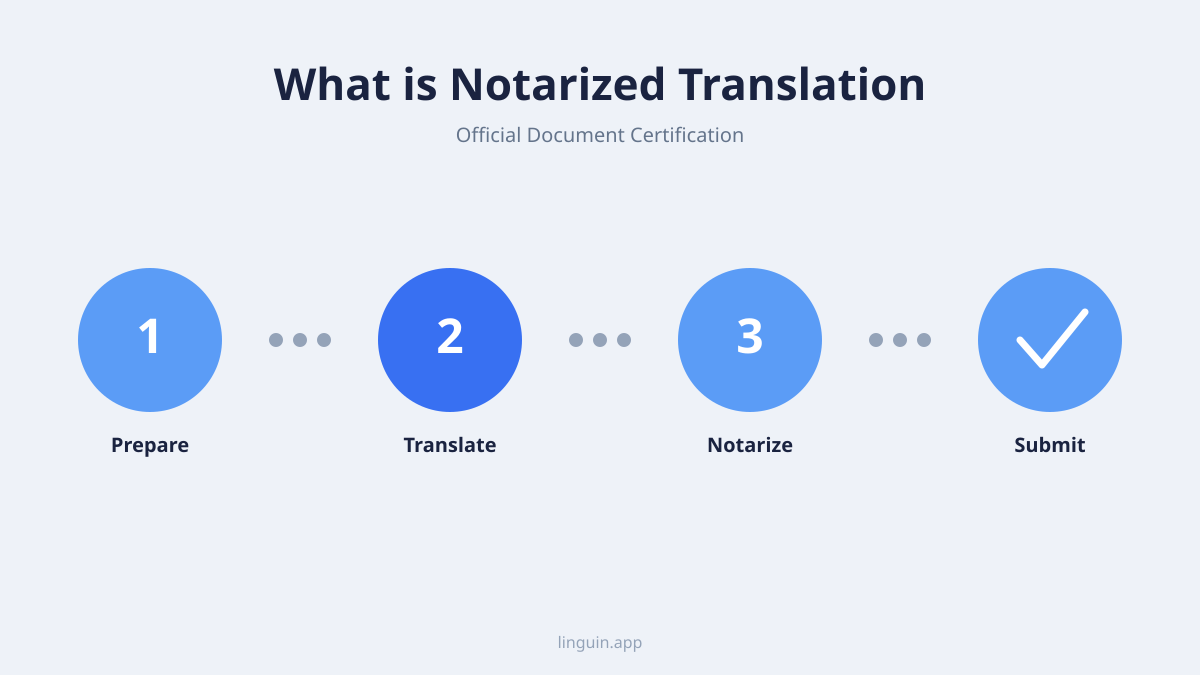
The step-by-step process for obtaining one
Obtaining a notarized translation involves a clear sequence of steps. Following them in order ensures the final document is valid and accepted.
-
Secure a professional translation. The first step is always to get an accurate translation from a qualified translator or agency. For official purposes, this should be a professional with expertise in the document’s subject matter (legal, medical, technical). The translator provides the translated text and prepares a draft certificate of accuracy.
-
Prepare the certification statement. The translator drafts a formal statement, often called a Translation Certification Affidavit. According to hicom-asia.com, this is a sworn statement attesting under penalty of perjury to the completeness and accuracy of a translated document. It includes the translator’s name, contact information, statement of competency, the date, and a signature line.
-
Schedule a notary appointment. The translator must sign the certificate in the physical presence of a commissioned notary public. Many translation agencies, like LinguaLinx, streamline this. According to Zipdo, LinguaLinx is a provider of certified notarized translation services, noted for building notarization packaging directly into its translation workflow.
-
Appear before the notary. The translator brings the original documents, the translation, the unsigned certificate, and government-issued photo identification (like a driver’s license or passport) to the notary. The notary verifies the translator’s identity, watches them sign the certificate, and then completes the notarization by adding their official seal, signature, commission number, and expiration date.
-
Assemble the final package. The final submission package typically includes the original source document (or a copy), the complete translation, and the notarized certificate of accuracy. These are often stapled together, with the notary’s seal sometimes overlapping pages to prevent substitution.
It is critical to confirm the specific formatting requirements with the receiving institution. Some may require the notary’s seal on every page, or a specific wording in the affidavit. Starting with a translation service experienced in notarized work for your target country or agency is the most reliable path.
Cost and pricing for certified and notarized services
The cost of a notarized translation is usually the sum of two services: the professional translation fee and the notary fee. Understanding the breakdown helps in budgeting and comparing quotes.
The translation fee is typically the largest component. Certified translation is generally billed per page, with a “page” defined as a standard 250-word document or a scanned page of the original. According to Bluente Blog, in 2026, certified translation is typically billed per page at roughly $20 to $60 per page, with USCIS-ready documents often quoted around $30 to $55 per page. Pricing varies based on language pair (common pairs like Spanish-English cost less than rare or complex pairs), document complexity (a birth certificate versus a technical patent), and turnaround time. According to Polilingua, certified translation at Polilingua is priced at $25 per page for standard documents, below the US market average.
The notary fee is a smaller, fixed cost. A notary public’s fee for an acknowledgment or jurat (the act of witnessing a signature) is often regulated by state law, typically ranging from $5 to $25 per signature. Many translation agencies include this fee in their bundled “notarized translation” package for convenience.
Additional potential costs include:
- Rush fees: For translations needed in 24-48 hours.
- Formatting fees: If the document requires precise replication of complex layouts, tables, or stamps.
- Shipping fees: For sending hard-copy originals and notarized returns.
- Apostille or authentication fees: If the document must be further legalized by the Secretary of State or the U.S. Department of State for international use, which involves separate fees and processing time.
When requesting a quote, provide the documents upfront so the agency can assess word count, complexity, and any special formatting needs. Ask if the quoted price includes the notary fee, and whether they handle the notarization in-house or if you need to arrange it separately.
Common mistakes and how to avoid them
Errors in the notarized translation process can lead to rejection, delays, and extra costs. Being aware of common pitfalls helps you navigate the process smoothly.
Mistake 1: Using a non-professional translator. For official documents, using a bilingual friend or a generic, non-certified AI translation tool is insufficient. Authorities require a statement from a qualified professional. While tools like Linguin provide excellent AI translation accuracy for everyday communication, they cannot provide the legally binding certification and notarization required for official submissions.
Mistake 2: Notarizing the wrong thing. A notary only verifies the signature on the certificate of accuracy, not the translation itself. Do not ask a notary to stamp the translated text pages directly unless specifically instructed. The notary’s seal belongs on the affidavit page where the translator signed.
Mistake 3: Incomplete certification statements. The translator’s affidavit must contain all necessary elements: a declaration of accuracy, statement of competency, identification of source and target languages, the date, and the translator’s signature. A generic statement missing key details may be rejected.
Mistake 4: Mismatched documents. The translation must be a complete, line-by-line representation of the original. Omitting stamps, marginal notes, or even blank lines can be grounds for rejection. The page count of the translation should match the original. For documents with complex visual elements, learn how AI can assist with multilingual legal document review to ensure nothing is missed before formal certification.
Mistake 5: Assuming all requirements are the same. The requirements for USCIS differ from those for a foreign university or a local county court. Always obtain the specific guidelines from the requesting institution in writing. Do not assume that because one agency accepted a format, another will.
To avoid these mistakes, work with a reputable translation service that specializes in certified and notarized work for your target institution. Provide them with the receiving authority’s guidelines. Review the translated draft carefully before it is finalized and notarized, checking for typos and completeness. Finally, plan ahead, as the notarization and any potential authentication steps can add days or weeks to the process.
The role of AI translation in the preparation workflow
AI-powered translation tools like Linguin are not substitutes for the formal notarized translation process, but they serve as powerful assistants in the preparation and review stages. They help reduce time, cost, and error in the initial phases.
Draft creation and comprehension. For personal reference or internal review, you can use an AI translator to get a clear, immediate understanding of a document’s content. For instance, before sending a complex foreign contract to a professional for certified translation, you could use Linguin’s Chrome extension to quickly grasp the key terms and clauses. This allows you to ask informed questions and identify potential issues early. Understanding cultural context is also vital, which is why tools that handle cultural context in marketing translation are valuable for grasping intent.
Terminology consistency. In projects involving multiple related documents, such as a series of patent filings or academic transcripts, AI can help ensure consistent translation of specialized terms across all texts. This provides a solid, uniform base for the human translator to refine and certify, improving overall quality. This is especially useful in fields like multilingual academic research.
Review and quality assurance. After a human translator produces a certified draft, AI can be used as a secondary check for potential omissions or glaring inconsistencies. It acts as an additional layer of scrutiny before the costly and final step of notarization. For documents with informal elements, an understanding of how AI handles informal grammar and slang can be part of this review.
The critical line to remember is that for any official submission requiring a certificate of accuracy or notarization, the final, binding version must be produced and vouched for by a qualified human professional. The AI tool is a partner in efficiency, not the legal certifier. Think of it as using a calculator to check your work before submitting a final math proof; the tool aids accuracy, but you are responsible for the final result.
Frequently asked questions
What is the difference between certified and notarized translation?
A certified translation includes a signed statement from the translator attesting to its accuracy and completeness. A notarized translation takes this further by having that translator’s signature witnessed and verified by a notary public. The notary confirms the translator’s identity but does not evaluate the translation’s quality. A document can be certified without being notarized, but a notarized translation always includes a certification.
Do I need a notarized translation for USCIS?
For most USCIS forms (like I-130, I-485), you need a certified translation, but notarization is not a requirement set by USCIS. The translator’s certificate of accuracy is sufficient. However, always double-check the specific instructions for your application, as other supporting documents or specific circumstances might have different rules from other government bodies.
How long does it take to get a notarized translation?
The timeline depends on the document’s length and complexity. A simple one-page document might be translated, certified, and notarized within 1-2 business days. More complex documents or rare language pairs can take several days for translation alone. Adding time for the translator to schedule a notary appointment and for shipping physical copies is important. Rush services are available at an additional cost.
Can I notarize a translation myself?
If you are a qualified translator, you can certify your own translation. You can then sign your own certificate of accuracy in front of a notary to have it notarized. The notary is verifying your identity as the signer, not your qualifications. However, many institutions prefer or require translations to be certified by a third-party professional or agency to ensure impartiality.
What languages are available for notarized translation?
Professional translation agencies typically offer certified and notarized services for a wide range of languages. According to Zipdo, certified and notarized translation services are used for legal and immigration processes across 90+ languages. Major world languages like Spanish, Mandarin, Arabic, and French are commonly available, while less common languages may require sourcing a specialized translator, which can affect cost and timeline.
Ensuring your documents are correctly prepared
Navigating the requirements for notarized translations is about understanding the purpose behind the request. The core need is for a verified, accurate translation that carries legal weight. Remember that certification addresses accuracy, while notarization addresses the authenticity of the signature on that certification. Always confirm the specific requirements with the institution that will receive your documents, as rules vary between USCIS, foreign embassies, universities, and courts.
For the official, binding step, you must engage a professional translation service. However, for all the steps leading up to that-understanding document content, checking drafts, and managing multilingual communication in other parts of your life or business-an AI translation tool can be an invaluable resource. It provides speed and accessibility for everyday translation needs, allowing you to focus your professional budget on the documents that truly require formal authentication.
To experience how AI can streamline your understanding of foreign text and casual multilingual conversations, you can try Linguin for free. It supports over 100 languages and is designed to integrate smoothly into your workflow on desktop and mobile devices, making preliminary translation tasks simpler and more efficient.
-vs-translator.png)