 English
  Español
  Français
  Deutsch
  Português
  Italiano
  Русский
  中文(简体)
  日本語
日本語  한국어
한국어  العربية
  हिन्दी
  Nederlands
  Türkçe
  Polski
Effective global marketing depends on more than just translating words. It requires the careful preservation of cultural context to ensure messages resonate authentically with local audiences. For marketers, brand managers, and business leaders expanding internationally, this is the key to building trust and driving engagement. This article explains how modern AI translation tools are engineered to understand and maintain this vital cultural context, moving beyond literal translation to deliver culturally intelligent campaigns.
Key takeaways
- AI translation models analyze entire sentences and paragraphs to infer the intended cultural meaning, not just individual words.
- These systems can adapt marketing tone, humor, and idioms to align with local norms and sensitivities.
- AI enables real-time, scalable cultural adaptation for dynamic marketing channels like social media and live chat.
What is cultural context in translation?
Cultural context refers to the web of shared knowledge, values, customs, and social norms that gives meaning to language. It is what makes a slogan inspiring in one country and puzzling or offensive in another. In marketing, every element carries cultural weight: the colors in an image, the metaphors in a tagline, the gestures in a video, and the implied values in a call to action. A direct, word-for-word translation often strips away this essential layer of meaning, leaving a message that feels foreign or misses the mark entirely.
For instance, a fast-food chain’s successful “finger-lickin’ good” campaign does not translate literally in many languages, where the phrase could be perceived as messy or rude. The cultural context here is about indulgence and taste, not the literal action. Similarly, individualism-focused appeals common in Western advertising may not connect in cultures that prioritize community and collective well-being. A translator must understand the core brand sentiment and find a culturally equivalent expression that evokes the same feeling.
This is where cultural competence becomes critical. It is the ability to navigate these nuances, recognizing that communication is deeply embedded in a society’s worldview. Modern AI translation is built on models trained on vast datasets of real-world language, encompassing literature, news, social media, and professional communications from across the globe. This exposure allows the AI to learn patterns of how ideas are expressed within specific cultural frameworks, moving it closer to true cultural competence than simple dictionary-based tools.
How AI models go beyond word substitution
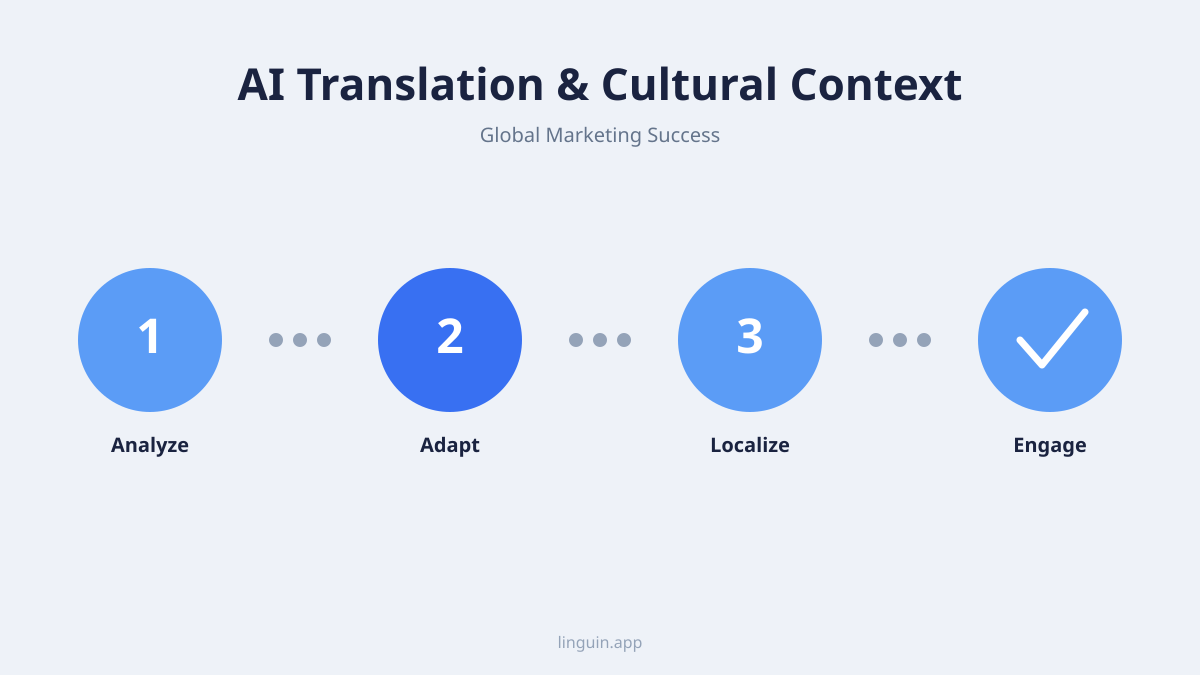
Traditional translation software often operated on a phrasebook model, swapping words between languages using a static dictionary. This approach fails because it ignores syntax, grammar, and, most importantly, semantics. Modern AI translation, particularly models based on neural machine translation (NMT) and large language models (LLMs), works fundamentally differently. It processes text as a complete, cohesive unit, analyzing the relationships between all words in a sentence or paragraph to predict the most accurate and natural-sounding output.
The process begins with contextual embedding. When you input a marketing slogan like “Think different,” the AI does not just see two separate words. It analyzes the entire phrase as a concept representing innovation, non-conformity, and creativity. It understands from its training that this is a branded statement with a specific aspirational tone. When generating a translation, the model searches its knowledge for equivalent concepts in the target language that carry a similar cultural and emotional weight, rather than translating “think” and “different” as isolated commands.
This capability is powered by attention mechanisms. These allow the AI to focus on the most relevant parts of the input text when generating each part of the output. For a complex product description, the AI can understand which technical terms are crucial, which adjectives are subjective praise, and which phrases are standard marketing boilerplate. It adjusts the translation style accordingly, ensuring that key selling points are emphasized and culturally specific claims are adapted. Say you’re launching a skincare product with the claim “light as air” in Southeast Asia. A basic tool might translate it literally, but an AI model, aware of the humid climate and local beauty ideals, might adapt the phrase to convey a feeling of “freshness” or “non-greasy comfort,” which are more relevant and desirable contextual benefits.
The role of training data in cultural understanding
The cultural intelligence of an AI translation system is directly tied to the quality, diversity, and volume of its training data. Models learn by identifying patterns in millions or billions of text examples. If trained predominantly on formal documents or news articles, the AI will excel at technical or neutral language but may struggle with the colloquial, persuasive, or trendy language of marketing. Therefore, the most effective systems are trained on a broad corpus that includes:
- Digital and social media content to capture contemporary slang, hashtags, and conversational tones.
- Marketing copy and advertisements from global brands to understand persuasive techniques and brand voices.
- Literature and film subtitles to grasp narrative, emotion, and nuanced expression.
- Regional news sources and forums to learn about local perspectives, sensitivities, and current events.
This diverse diet allows the AI to develop a sense of cultural registers. It learns that a social media post for a youth fashion brand in Brazil requires a different tone and vocabulary than a corporate white paper for German engineers. It can discern when a phrase is meant to be ironic, when a reference is regionally specific, and when a certain formality level is expected. For example, an AI trained on sufficient Japanese data will understand the importance of honorifics and levels of politeness, crucial for any customer-facing marketing material.
Furthermore, continuous learning is key. Language and culture are not static. New words, memes, and social norms emerge constantly. Advanced AI translation platforms incorporate mechanisms for ongoing model refinement, integrating new linguistic data to stay current. This ensures that a marketing campaign today can accurately use the language of its audience, avoiding the pitfall of sounding outdated or out of touch. You can learn more about how training impacts output in our article on AI translation accuracy.
Adapting tone, humor, and idioms for local markets
Perhaps the greatest challenge in marketing translation is conveying tone, humor, and figurative language. These elements are deeply cultural and often non-transferable in their original form. AI translation with strong contextual understanding provides sophisticated solutions for these challenges.
Tone adaptation is automatic in advanced systems. A friendly, casual brand voice in English, using contractions and active voice, can be adjusted to the appropriate level of familiarity in the target language. In some cultures, a more respectful or formal tone might be necessary even for casual products, while in others, an overly formal tone could create distance. The AI assesses the source tone and aligns it with culturally appropriate linguistic structures.
Humor and sarcasm are high-risk, high-reward elements. A pun or joke that lands well in one language may have no equivalent or may even cause confusion. AI models trained on comedic scripts, sitcom subtitles, and social media banter can identify humorous intent. Instead of attempting a direct translation that fails, the system can often suggest a cultural substitution. For instance, a witty tweet playing on a English homophone might be replaced by a different, locally relevant play on words that maintains the brand’s clever personality. We explore this delicate balance further in our guide to AI translation for humor and sarcasm.
Idioms and metaphors require conceptual translation. A phrase like “break a leg” or “the ball is in your court” would be nonsense if translated word-for-word. AI models recognize these as fixed expressions. They search for idioms in the target language that convey a similar sentiment, such as “merde” in French or “toi toi toi” in German for wishing good luck. For metaphors, the AI extracts the core analogy. “A storm of controversy” might become “a wave of criticism” or “a fire of debate,” depending on what natural imagery resonates in the target culture. Discover how AI handles these nuanced phrases in our article on AI translation for idioms and cultural nuances.
Practical applications in global marketing channels
The ability to preserve cultural context at scale transforms how brands execute global campaigns across multiple digital channels.
Social Media and Content Marketing: Speed and cultural relevance are paramount. AI translation tools can localize posts, stories, and video captions in real-time, allowing community managers to engage with global audiences simultaneously. They can adapt trending topics and hashtags to make them relevant locally. Say you’re running a user-generated content campaign asking customers to share their “cozy moments” with your product. In Scandinavia, “hygge” might be the perfect conceptual fit, while in Japan, “kotatsu” could be a more relatable anchor. An AI can help identify and integrate these concepts seamlessly.
Email Marketing and Newsletters: Personalization drives engagement. AI enables the segmentation and translation of email campaigns while maintaining a consistent brand voice. It can adjust subject lines for higher open rates, localize offers (considering local holidays like Diwali or Singles’ Day instead of Black Friday), and ensure that call-to-action buttons use the most persuasive phrasing for that culture. For insights on adapting tone in professional communication, see our piece on AI translation for formal and informal tone in emails.
E-commerce and Product Listings: Converting browsers into buyers requires clear, compelling, and trustworthy descriptions. AI translation can localize thousands of product titles, descriptions, and specifications accurately. More importantly, it can adapt marketing claims to comply with local advertising regulations and consumer expectations. A description touting “the world’s best” might need to be softened in markets with strict comparative advertising laws, and size guides or care instructions must use local measurement units and standards.
Customer Support and Live Chat: This is where real-time cultural nuance is critical. AI-powered translation in chat windows allows support agents to communicate with customers in their native language. The AI can be tuned to use a helpful, patient, and polite tone that aligns with local customer service expectations, helping to de-escalate frustrations and build loyalty. Learn about implementing this in AI translation for multilingual customer support.
Ensuring brand consistency across languages
A major concern for global brands is maintaining a unified brand identity while adapting messages for local markets. Inconsistent translations can dilute brand equity and confuse customers. AI translation, when configured correctly, acts as a force for brand consistency.
The first step is the development of a custom glossary and style guide. Leading AI translation platforms allow companies to upload their official brand terminology, preferred translations for key product names, and tone-of-voice guidelines. The AI model then prioritizes these approved terms and stylistic rules during translation. For example, if your brand always uses “clients” instead of “customers” and has a specific translation for your flagship product, the AI will adhere to those standards across all materials.
Secondly, AI enables centralized management of translation projects. Marketing teams can manage campaigns for multiple regions from a single dashboard, using the same AI engine for all languages. This ensures that the core brand message is interpreted through a consistent linguistic lens. Updates to brand messaging can be propagated quickly and uniformly across all localized versions.
Finally, the contextual understanding of AI helps maintain emotional and experiential consistency. While the words change, the AI works to preserve the intended brand feeling, whether it’s excitement, trust, sophistication, or empowerment. This means a campaign designed to inspire adventure will carry that same emotional core in every language, even if the specific imagery or metaphors used to evoke it differ. For businesses managing distributed teams, tools like Linguin help maintain this consistency; explore AI translation for remote multilingual teams for strategies.
Limitations and the human-in-the-loop model
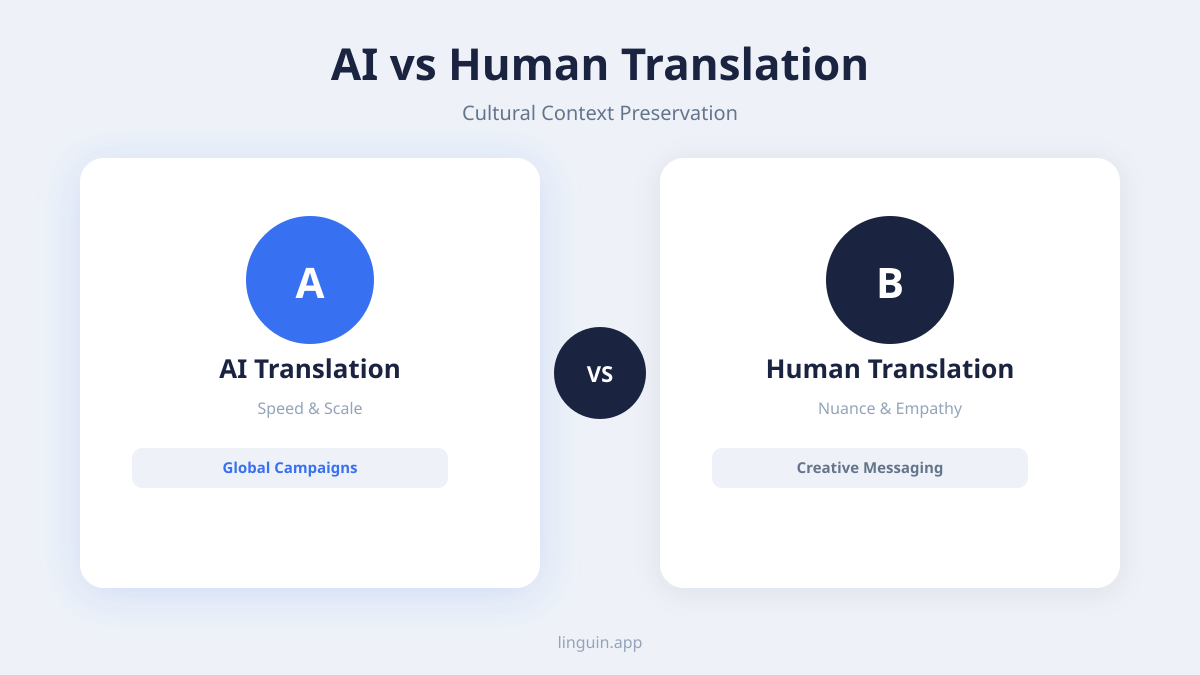
While AI translation has made remarkable strides in cultural adaptation, it is not infallible. Its understanding is based on patterns in data, not lived human experience. There are areas where human oversight remains essential.
Deep Cultural Nuances and Historical Sensitivities: An AI might correctly translate text about a historical event but lack the deeper understanding of its emotional and political legacy in a specific region. A human expert is needed to navigate these sensitivities and avoid unintended offense.
Creative Brand Storytelling: Highly creative, narrative-driven campaigns (like a brand origin story or a cinematic ad) often rely on poetic language and abstract concepts. While AI can provide a strong foundational translation, a human copywriter or transcreator should refine it to ensure the storytelling magic is not lost.
High-Stakes Legal and Compliance Documents: Marketing claims, terms of service, and disclaimers have legal implications. Final translations of such materials should always be verified by a legal professional fluent in the target language to ensure absolute precision and compliance.
Therefore, the most effective workflow for global marketing is a human-in-the-loop model. AI handles the bulk of the translation work, ensuring speed, scalability, and strong contextual accuracy. Human marketing linguists or regional managers then review the output. Their role shifts from translating from scratch to editing and perfecting, focusing on high-level creative and cultural polish. This hybrid approach maximizes efficiency while safeguarding brand integrity.
Frequently asked questions
Can AI translation handle marketing slogans and taglines effectively?
Yes, modern AI translation can be very effective with slogans, as it focuses on translating the core concept and emotional intent rather than the literal words. By analyzing the brand’s context and the slogan’s purpose, it seeks equivalent phrases in the target language that evoke a similar response. For the best results, it should be used alongside a custom brand glossary and receive final approval from a native-speaking marketer to ensure perfect brand alignment.
How does AI translation avoid cultural mistakes or offensive translations?
AI models are trained on vast amounts of vetted text data, which helps them learn appropriate language use and recognize potentially sensitive terms. They use context to discern meaning, reducing the chance of blunt, inappropriate translations. However, they are not perfect. The best practice is to use AI translation as a powerful first draft, followed by review by someone with native cultural knowledge, especially for campaigns in new or sensitive markets.
Is AI translation cost-effective for small businesses going global?
Absolutely. AI translation dramatically reduces the time and cost per word compared to traditional human-only translation services. It allows small businesses to localize their website, product listings, and marketing emails at a fraction of the cost, enabling them to test new markets with lower risk. Many platforms offer scalable pricing, making professional-grade translation accessible for businesses of any size.
How do I ensure the AI uses the correct dialect for my target audience?
Advanced AI translation platforms often allow you to specify regional variants, such as Spanish (Mexico) vs. Spanish (Spain), or Portuguese (Brazil) vs. Portuguese (Portugal). By selecting the correct target locale, you guide the AI to use the appropriate vocabulary, spelling, and cultural references for that specific region, which is crucial for authentic marketing. Learn more about this in our article on AI translation for regional dialects in business.
Integrating cultural AI into your marketing workflow
The journey to culturally intelligent global marketing begins with recognizing translation as a strategic function, not just a tactical step. By leveraging AI that understands context, brands can communicate with authenticity and precision across borders. The key is to move from simply translating words to adapting meaning, using technology to maintain brand consistency while allowing for necessary local flavor.
Start by auditing your current marketing assets. Identify which materials, from your website core messaging to your social media calendar, would benefit most from localization. Then, integrate an AI translation tool like Linguin into your content creation pipeline. Use it to generate initial localized drafts for review, build a custom glossary of your brand terms, and empower your regional teams with the ability to adapt content quickly. This approach allows you to scale your global presence thoughtfully, ensuring every campaign resonates as intended, no matter the language.