 English
 Español
 Français
 Deutsch
 Português
 Italiano
 Русский
 中文(简体)
 日本語
 한국어
 العربية
 हिन्दी
 Nederlands
 Türkçe
 Polski
A Tamil to English translation app is an essential tool for anyone navigating between these two distinct languages. Whether you are a professional, a student, a traveler, or someone connecting with family, finding the right app can transform communication. This guide provides a comprehensive comparison of current apps, from their core features to their best use cases, so you can choose the best solution for your needs.
Key takeaways
- AI-powered apps now offer context-aware translations that handle Tamil’s complex grammar and cultural nuances more effectively than older rule-based systems.
- Key features to prioritize include offline functionality for travel, document and image translation for work, and conversation mode for real-time dialogue.
- Pricing models vary widely, from free government-sponsored apps to subscription services and per-word fees for professional document translation.
Why Tamil to English translation is uniquely challenging
Translating between Tamil and English presents specific hurdles that generic translation tools often stumble over. Tamil is a Dravidian language with a rich literary history spanning over two millennia. Its agglutinative nature means words are formed by stringing together morphemes, creating long, complex words that carry meanings which English would express with entire phrases or sentences. The language also features a diglossic situation, where the formal, written form differs significantly from the many regional spoken dialects. A translation app must navigate these variations.
The grammatical structures are fundamentally different. Tamil uses a subject-object-verb (SOV) order, while English follows subject-verb-object (SVO). Tamil nouns have eight cases, and verbs conjugate based on tense, person, gender, number, and mood, creating a matrix of possible forms. Direct, word-for-word translation results in awkward, often incomprehensible English. For example, a common Tamil greeting like “வணக்கம்” (vaṇakkam) conveys a sense of respectful salutation that a simple “hello” does not fully capture. An effective app must interpret the intent and cultural weight behind the words.
Beyond grammar, cultural context is critical. Tamil has a vast repository of proverbs, idioms, and literary references that are deeply rooted in South Indian culture. Translating these requires more than dictionary substitution; it requires the app to understand the underlying metaphor and find a culturally appropriate equivalent in English. This is where modern AI-powered translation moves beyond simple dictionary lookup. By analyzing vast amounts of parallel text, these systems learn patterns of how ideas, not just words, are converted between the languages, producing more natural and contextually accurate output.
Types of Tamil to English translation apps
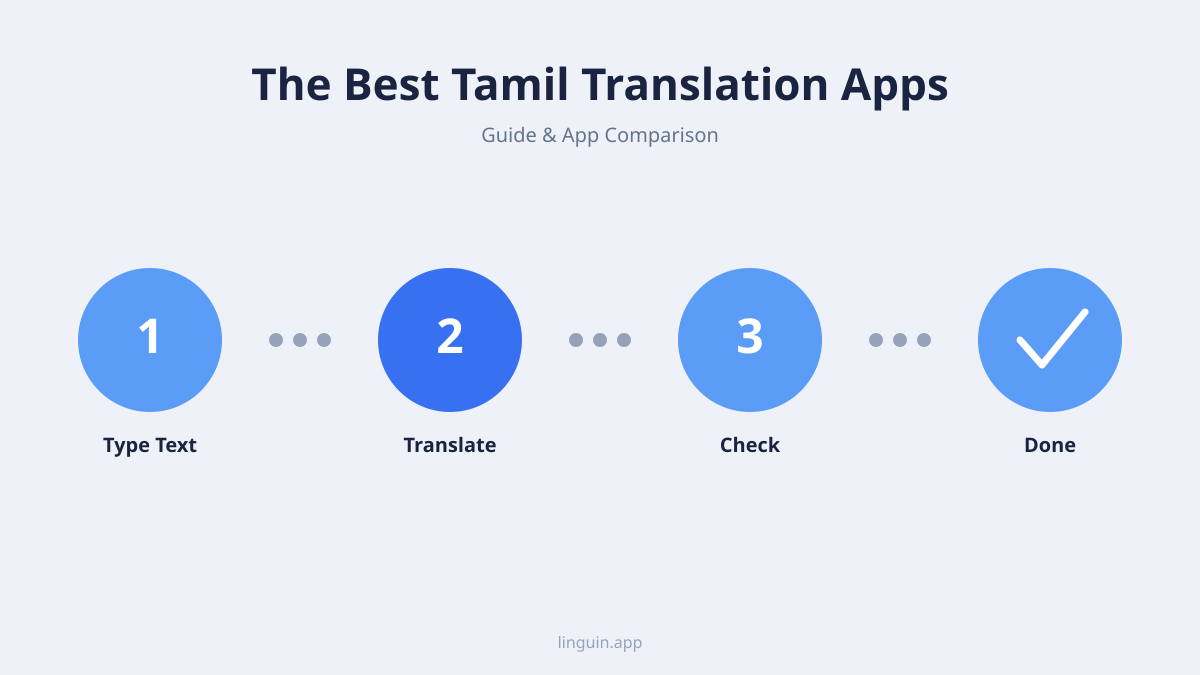
The landscape of translation tools is diverse, with each type serving a distinct primary function. Understanding these categories helps you match the tool to your specific task.
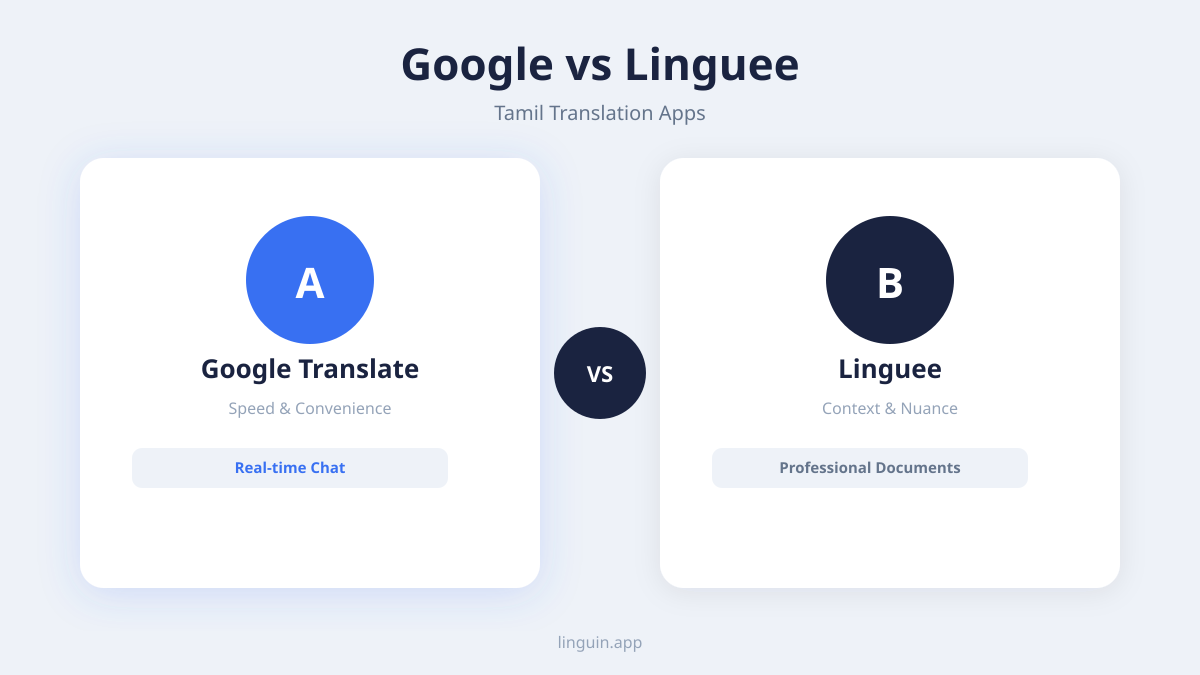
General-purpose translation platforms are the most common. These are apps or websites designed for quick, on-the-fly translation of typed text. They are ideal for looking up a word, understanding a short message, or getting the gist of a sentence. Their strength lies in speed and convenience. For instance, if you receive a Tamil SMS and need to understand it immediately, a general-purpose app is the fastest solution. However, they may lack depth for longer, more complex texts.
Specialized learning and language apps focus on teaching and gradual comprehension rather than instant translation. They often include gamified lessons, vocabulary builders, and grammar explanations. For example, Duolingo launched a ‘Learn English from Tamil’ course in January 2025, according to The Indian Express, making it the fourth Indic language course on its platform. These apps are excellent for someone who wants to build long-term proficiency, but they are not designed for translating a document or having a live conversation.
Integrated keyboard and productivity tools embed translation directly into your typing flow. An AI keyboard app like Typeit4U offers a free plan that includes translation from Tamil and Hindi to English, per Typeit4U. This is useful for multilingual communication in messaging apps, email clients, or social media, as you can type in one language and have it translated inline without switching to a separate app. This streamlines the process of replying to messages in a different language.
Document and media translation services cater to professional needs. They handle entire files, preserving formatting for documents like PDFs and Word files, or providing subtitles for video and audio. These services often use more advanced models and may involve a cost. For instance, Translate.com charges $0.07 per word for editable Tamil to English document translation and $25 per page for non-editable documents, according to Translate.com. This is the category to choose for translating a business contract, an academic paper, or a website.
Key features to look for in a translation app
When evaluating a Tamil to English translation app, several features separate basic tools from indispensable ones. The right combination depends on your primary use case.
Translation accuracy and context handling is the foundational feature. Look for apps that mention the use of advanced AI models like GPT, Claude, or Gemini, as these are better at understanding context. For example, Google Translate integrates the Gemini AI model for improved Tamil translation accuracy, a feature noted in 2024, according to TechShali. An app should handle not just single words but also sentences where meaning depends on the surrounding text. The ability to translate idioms or culturally specific phrases accurately is a strong indicator of a sophisticated engine.
Offline functionality is crucial for travelers or anyone without reliable internet access. Some apps allow you to download language packs for use anywhere. A Tamil-English translator app on Google Play, updated in October 2026, offers offline translation for text, voice, and camera, though its conversation mode requires an internet connection, per Google Play. Check the size of the offline package and which features remain available without a connection.
Input and output modes define how you interact with the app. The essential modes are:
- Text: Typing or pasting text.
- Voice: Speaking into the app for instant speech-to-text translation and often text-to-speech playback of the result.
- Camera: Pointing your camera at text in the real world, like a street sign or a menu, for instant overlay translation.
- Conversation: A two-way mode that alternates between languages for live dialogue.
- Document & Image Upload: Uploading files or photos of documents for translation.
A comprehensive app like the Tranlis Tamil to English translator uses models including GPT-5, Claude 4, and Gemini 2.5 and supports translation across text, documents, images, audio, and video, according to Tranlis. For more on how AI handles different content types, our guide on AI translation for multilingual academic research papers explores these capabilities in depth.
Additional useful features include phrasebooks for travelers, history and favorite saves for frequently used translations, and the ability to suggest alternative translations or flag potential errors. For professional or creative work, consider how the app handles cultural context in marketing or the subtleties of formal and informal tone in emails.
Top use cases and scenarios
Understanding real-world applications helps illustrate which app features matter most. Here are two concrete scenarios.
Scenario 1: The business professional. You are reviewing a project proposal drafted by your team in Chennai. The document is in Tamil, but you need to provide feedback in English for stakeholders in London. You need an app that can accurately translate the entire document while preserving technical terminology and formal tone. A document translation service with editable output would be ideal here. After translation, you might use a second tool to help draft your English feedback, ensuring it is diplomatically worded and clear. This process relies heavily on the app’s understanding of professional jargon and formal register.
Scenario 2: The traveler or family visitor. You are visiting relatives in Tamil Nadu. You need to navigate local transportation, read food labels, and have basic conversations with shopkeepers and relatives who speak limited English. For this, an app with robust offline camera and conversation modes is essential. You could point your camera at a bus destination sign to confirm your route, use the camera on a restaurant menu to decide what to order, and use conversation mode to have a simple talk with a local artisan about their craft. The speed and offline reliability of the translation are more critical than perfect literary accuracy. For managing such multilingual interactions on the go, a tool like Linguin’s mobile app can be particularly useful.
Other common use cases include students translating academic resources, content creators localizing social media posts or video subtitles, and customer support teams handling inquiries in multiple languages. For those in support roles, exploring AI translation for multilingual customer support can provide specific strategies.
Comparing popular Tamil to English translation tools
The market offers a range of options, from free government initiatives to premium professional services. Here is a comparison based on the available research.
Free and government-supported apps provide essential services without cost. The ‘Bhashini’ translation app, developed under India’s National Language Translation Mission, is being promoted by the government for free use in Puducherry, according to The Hindu. These apps focus on accessibility and basic communication needs for the public, often supporting multiple Indian languages. Their translation quality can be good for common phrases but may lack the nuanced accuracy of commercial AI models for complex text.
Freemium and subscription-based apps offer a free tier with basic features and charge for advanced capabilities like offline packs, higher character limits, ad-free experiences, or professional document translation. Many of the popular apps on app stores follow this model. The value lies in testing the core translation engine for free before committing. It is important to check what the paid subscription specifically offers for Tamil-English translation, as not all features are equally developed for all language pairs.
Professional translation services cater to businesses and individuals requiring guaranteed accuracy and formatting. As noted, Translate.com charges per word or per page. These services often employ human post-editing or specialized enterprise AI models. They are the appropriate choice for legal documents, published materials, or any translation where error is not an option. For insights into how AI assists in such high-stakes fields, our article on AI translation for multilingual legal document review is a relevant resource.
When comparing, consider not just price but also supported formats, speed, and the provider’s transparency about the AI models used. An app that openly states it uses models like GPT-5 or Gemini 2.5, as Tranlis does, gives you a clearer idea of its technological foundation.
The role of AI in modern Tamil translation
Artificial Intelligence has shifted translation from a mechanical process to an interpretive one. Early rule-based systems tried to codify grammar rules and dictionary mappings, which failed with Tamil’s complexity. Statistical machine translation introduced probability, looking at patterns in vast bilingual text corpora, but still produced literal and often clumsy outputs.
Modern neural machine translation (NMT), powered by AI models, represents a leap forward. These systems use deep learning networks to process entire sentences as contextual units. They learn to represent the meaning of a Tamil sentence in a multi-dimensional space and then generate the most natural English sentence that occupies a similar meaning space. This allows them to handle word order differences, idiomatic expressions, and contextual cues more effectively.
The latest frontier involves large language models (LLMs) like GPT-4 and its successors. These models, trained on a significant portion of the world’s text, have a profound understanding of language semantics and world knowledge. When applied to translation, they can make more informed decisions. For example, when translating a Tamil text about classical Bharatanatyam dance, an LLM might recognize specialized terms and choose appropriate English equivalents that preserve the artistic context, something earlier systems would miss. This leads to translations that sound more native and retain the original’s intent. The ongoing improvements in AI translation accuracy are largely driven by these advances.
However, challenges remain. AI can still struggle with the lowest-resource Tamil dialects, highly poetic or archaic text, and content that requires deep cultural knowledge not fully represented in training data. The field is actively working on these limitations, including efforts for preserving endangered languages.
Frequently asked questions
What is the most accurate Tamil to English translation app?
Accuracy depends on the type of text. For general sentences and modern text, apps using advanced AI models like GPT, Claude, or Gemini typically offer the best results. For specific needs like legal documents, a professional service with human review is the most accurate. It is advisable to test a few apps with sample text relevant to your use case.
Can I use a translation app offline in Tamil Nadu?
Yes, but you must plan ahead. Many apps offer downloadable language packs for offline use. You need to download these packs via Wi-Fi before your travel. Offline mode usually supports text and camera translation, but real-time conversation mode and voice translation often require an internet connection. Always verify the app’s offline capabilities before relying on it in a remote area.
Are free translation apps safe for sensitive documents?
No, it is not recommended to use free, general-purpose translation apps for sensitive personal, financial, or legal documents. The text you submit may be stored, analyzed, or used to improve the service, as per the app’s privacy policy. For sensitive material, use a professional, paid service that guarantees data confidentiality and security, or consider offline apps that process data locally on your device.
How does AI handle Tamil’s formal and informal speech?
Advanced AI translation models are trained on diverse text sources, which include examples of both formal (சங்கத Tamil) and informal (கொச்சை Tamil) speech. A good app can often detect the register from context and translate accordingly. “நீங்கள்” (nīṅkaḷ) is the formal “you,” while “நீ” (nī) is informal; an AI model should translate these to appropriate English equivalents based on the surrounding text’s tone. Some apps may also allow you to manually select a formal or informal translation style.
What’s the difference between a translator app and a language learning app?
A translator app is designed for immediate comprehension and communication. It converts text or speech from one language to another instantly. A language learning app, like Duolingo, is designed to teach you the language through structured lessons, vocabulary practice, and grammar exercises over time. It may include translation exercises, but its goal is education, not instant conversion. Use a translator for quick help; use a learning app for long-term skill building.
Choosing the right tool for your needs
Selecting the best Tamil to English translation app ultimately comes down to matching its strengths to your specific requirements. For quick, everyday translations and travel, a robust mobile app with offline camera and voice features is indispensable. For professional or academic work involving documents, a dedicated service that preserves formatting and handles specialized terminology is necessary. For long-term learning, a dedicated language platform will serve you better than a translation tool.
The core considerations remain accuracy, supported features, cost, and ease of use. The integration of sophisticated AI has dramatically improved the quality of machine translation, making these tools more reliable for a wider range of tasks than ever before. As these models continue to evolve, their ability to grasp cultural nuance and context will only deepen.
Your next step is to identify your most frequent translation scenario from the examples discussed and test one or two recommended apps in that context. For a versatile AI-powered translator that works across devices and contexts, you can try Linguin to see how modern translation handles your specific Tamil to English needs.