 English
  Español
  Français
  Deutsch
  Português
  Italiano
  Русский
  中文(简体)
  日本語
日本語  한국어
한국어  العربية
  हिन्दी
  Nederlands
  Türkçe
  Polski
AI translation is the key to unlocking your podcast for a global audience by automating transcription and localization. For creators, businesses, and media houses, this means moving beyond a single-language audience without prohibitive costs or time delays. This article will guide you through the entire process, from converting speech to accurate text in multiple languages to culturally adapting that content for listeners worldwide.
Key takeaways
- AI can automatically transcribe audio into text and translate it into over 100 languages with high accuracy and contextual awareness.
- Localization goes beyond literal translation, adapting humor, cultural references, and idiomatic expressions for specific regional audiences.
- A streamlined workflow of transcription, translation, and localization can drastically reduce production time for multilingual podcast versions.
- Multilingual transcripts and subtitles improve accessibility and discoverability, making content available to non-native speakers and search engines.
- Integrating AI translation tools directly into your creative suite allows for real-time collaboration and content iteration across language barriers.
The foundation: from audio to accurate multilingual text
The journey to a multilingual podcast begins with transforming spoken words into written text. Automatic Speech Recognition (ASR) is the AI technology that powers this first critical step. Modern ASR systems are trained on vast datasets of diverse voices, accents, and audio qualities, allowing them to generate a reliable transcript of your podcast episode. Accuracy here is paramount, as any error in transcription will propagate through translation.
Once you have a clean transcript, the next phase is multilingual podcast transcription translation. This is not a simple two-step process of transcribing then translating. Advanced AI systems can now handle these tasks in a more integrated manner, understanding the context from the audio to inform the text output. For instance, an AI model listening to a conversation in Spanish can generate an English transcript that has already begun to interpret meaning, not just words. This context-aware approach is crucial for handling the natural flow of podcast dialogue, which includes interruptions, colloquial speech, and industry-specific terminology.
The output is a base transcript in the podcast’s original language and parallel transcripts in multiple target languages. This creates a versatile asset. Say you’re interviewing a tech founder in Berlin who switches between German and English. An AI tool can transcribe both languages accurately, then provide a unified, translated transcript in Japanese for your investor audience in Tokyo. This foundational text becomes the source for all further localization efforts, from creating show notes to generating subtitles for video podcasts. For a deeper look at what makes modern translation accurate, you can read about the factors behind AI translation accuracy.
Beyond word-for-word: the art of AI-powered localization
Translation provides the literal meaning, but localization delivers the experience. For a podcast to resonate in a new market, the content must feel native. This involves adapting cultural references, humor, idioms, and even pacing to suit the target audience. AI models trained on regional media, literature, and social data are now capable of this nuanced work.
Consider cultural context. A podcast host making a joke about a popular American TV show from the 1990s might leave international listeners confused. During localization, an AI system can identify this reference and suggest an equivalent cultural touchstone from the target region, or provide an explanatory note that keeps the intent of the humor intact. Similarly, idioms like “spill the beans” or “bite the bullet” require transcreation finding a phrase in the target language that conveys the same idea, not a literal translation that becomes nonsense.
This extends to tone and formality. A business podcast requires a different register than a casual comedy show. AI can be instructed to maintain a formal tone for a legal commentary podcast being localized for a French audience, or adopt a more informal, conversational style for a lifestyle podcast entering the Brazilian market. The goal is to preserve the host’s unique voice while making it intelligible and relatable abroad. For example, a host’s passionate, fast-paced delivery in Italian might be localized for a Korean audience by slightly adjusting sentence structures to match preferred narrative rhythms, all while keeping the core energy and message. Learn more about how AI handles these subtle challenges in our article on translation for humor and sarcasm.
Building a scalable multilingual podcast workflow
Efficiency is critical when managing multiple podcast episodes across several languages. A manual process quickly becomes unsustainable. An AI-augmented workflow creates a scalable pipeline that maintains quality while saving hundreds of hours.
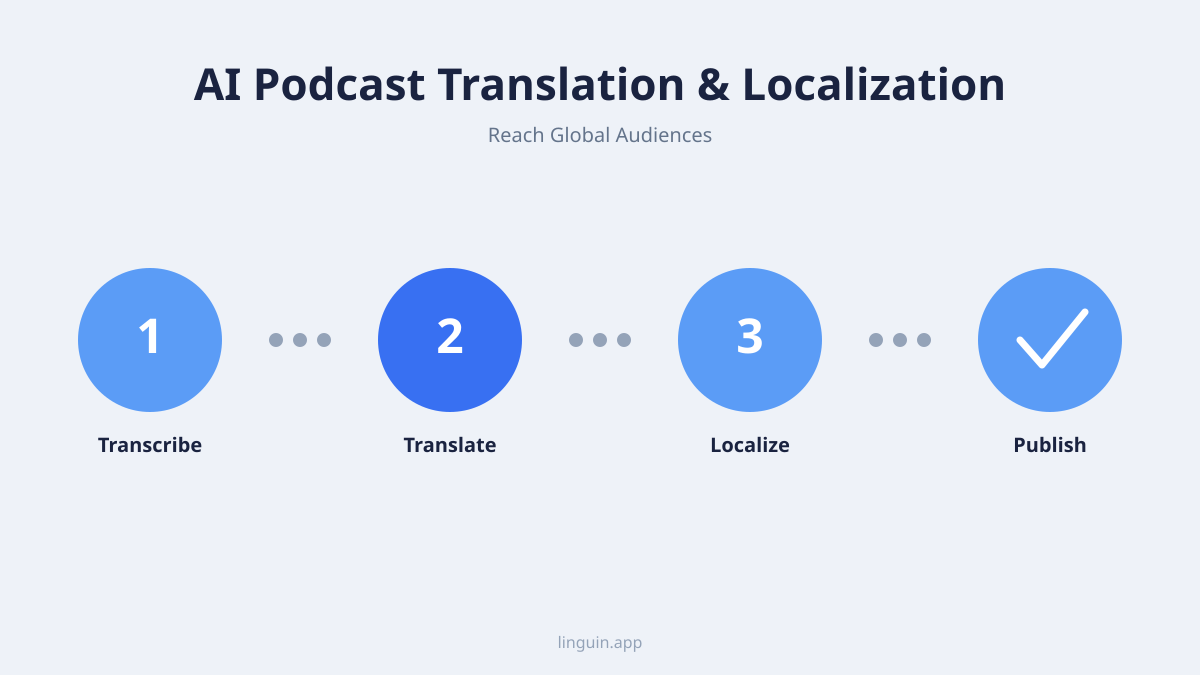
A typical optimized workflow has several connected stages. First, the raw audio file is processed through an ASR system to create a time-coded transcript. This transcript is then fed into a translation AI, which produces drafts in all target languages. These drafts undergo a contextual review, where another AI layer checks for consistency in terminology, speaker labels, and cultural appropriateness. The output is a package containing the original transcript, all translated transcripts, and often an initial set of subtitles for video platforms.
This automation allows for powerful repurposing. From your translated transcripts, you can automatically generate:
- Multilingual blog posts and show notes for your website.
- Social media snippets and quote graphics tailored for different regions.
- Closed captions and subtitles for video podcasts on YouTube or Vimeo.
- SEO-optimized text to help your podcast rank in search results across languages.
- Accessible content for hearing-impaired audiences in their native language.
Imagine you run a weekly news analysis podcast. With this workflow, within hours of recording, you can publish the episode with transcripts and show notes in English, Spanish, and Mandarin. Your social media manager immediately has accurate quotes in all three languages to promote the episode across regional channels. This speed and consistency help build a coordinated global brand presence. Discover how similar workflows benefit multilingual project management.
Enhancing accessibility and global discoverability
Multilingual podcast transcription translation serves two powerful goals: inclusion and growth. By providing transcripts and translations, you make your content accessible to a wider range of people, including those who are deaf or hard of hearing, non-native speakers, and individuals in sound-sensitive environments. This is not just an ethical best practice, it significantly expands your potential listener base.
From a growth perspective, text is discoverable by search engines in a way that raw audio is not. A transcript full of relevant keywords acts as a sitemap for search engine crawlers. When you provide this transcript in multiple languages, you index your content for search queries performed in those languages. A listener in Seoul searching for “sustainable architecture trends” in Korean can now find your English-language podcast episode because you have a professionally translated Korean transcript posted on your site.
Furthermore, platforms like YouTube and Spotify use transcript data to understand content and improve their recommendation algorithms. Multilingual subtitles increase watch time and engagement metrics, signaling to the platform that your content is valuable for a global audience, which can lead to broader promotion within their apps. This creates a virtuous cycle: accessibility features drive discovery, which grows your audience, which justifies further investment in localization. This principle is key for multilingual SEO content strategy.
Choosing and integrating the right AI translation tools
Selecting an AI translation solution for your podcast needs requires evaluating a few key criteria. The tool must support a wide range of source and target languages, ideally over 100, to give you flexibility. It should offer high accuracy not just in general language, but in your specific niche, whether that’s technology, finance, medicine, or entertainment. The ability to handle industry-specific terminology and proper nouns correctly is non-negotiable.
Integration is another major factor. The best tools offer APIs or direct plugins that connect with your existing podcast production stack. This might mean a tool that integrates with your audio editing software, your content management system like WordPress, or your subtitle generation platform. This seamless connection prevents the need for cumbersome file exports and imports, keeping your workflow smooth.
Look for features that support the entire localization pipeline:
- Batch processing for translating multiple episodes or transcript segments at once.
- Custom glossaries to ensure brand names, technical terms, and unique phrases are translated consistently every time.
- Collaboration features that allow human reviewers to suggest edits, add notes, and approve final translations within the platform.
- Voice preservation options, where some systems can even synthesize the translated text in a voice that matches the original speaker’s tone, useful for short clips.
For podcasters who work across devices, using a dedicated AI translator for Mac or a browser extension can facilitate quick checks and translations during the research or script-writing phase, long before the final audio is ready.
Addressing common challenges in podcast translation
Even with advanced AI, podcast localization presents unique hurdles. Spoken language is messy. It contains false starts, interruptions, overlapping dialogue, and heavy use of slang. AI models must be robust enough to navigate this. A key challenge is speaker diarization, which is correctly identifying “who said what” in a multi-person conversation. Accurate diarization is essential for creating readable transcripts and for maintaining the conversational flow in translation.
Another significant challenge is code-switching, where speakers blend multiple languages within a single sentence. This is common in podcasts featuring bilingual hosts or international guests. An effective AI system must recognize the shift in language, transcribe each part correctly, and then translate the intent seamlessly for a monolingual reader in the target language. It must understand that the switch is intentional and not an error. Our article on translation for mixed languages explores this in detail.
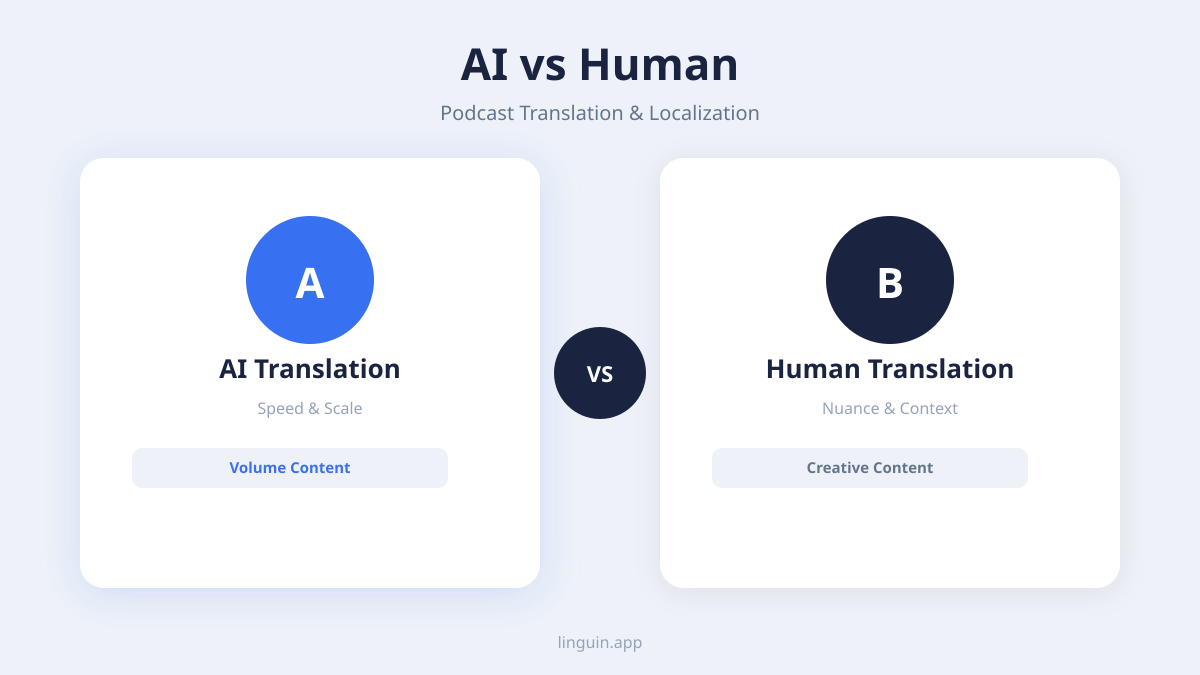
Finally, there is the balance between AI automation and human oversight. While AI handles the bulk of the work efficiently, a human reviewer familiar with both cultures is invaluable for the final polish. This reviewer checks for subtle cultural missteps, ensures humor lands correctly, and verifies that specialized jargon is accurate. The optimal model uses AI for the heavy lifting of transcription and draft translation, freeing human experts to focus on high-value creative and cultural refinement.
Frequently asked questions
Can AI accurately translate humor and sarcasm in podcasts?
Yes, modern AI translation models have become adept at recognizing linguistic cues for humor and sarcasm. They analyze context, tone indicators, and cultural frameworks to determine intent. Instead of translating a sarcastic phrase literally, the AI will seek to convey the same ironic or humorous meaning using appropriate devices from the target language. However, highly nuanced or culture-specific jokes may still benefit from a human editor’s final touch.
How does multilingual transcription help with podcast SEO?
Search engines cannot listen to audio. Transcripts provide searchable text that allows engines to index your podcast’s content. By providing these transcripts in multiple languages, you make your podcast discoverable for search queries in those languages. This drives organic traffic from a global audience to your website or hosting platform, directly from people searching for topics you cover in their native tongue.
What is the difference between translation and localization for audio content?
Translation converts the words from one language to another. Localization adapts the entire content experience for a specific region or culture. For a podcast, localization might involve changing cultural examples, adapting measurements or currencies, modifying humor, and even adjusting the pacing of dialogue descriptions in show notes to match local consumption habits. Translation is part of localization, but localization is the comprehensive process.
How long does it take to transcribe and translate a podcast episode with AI?
The time required depends on the length of the episode, the number of target languages, and the specific tools used. For a 60-minute episode, high-quality AI transcription can take just a few minutes. Subsequent translation into 5 different languages might add another 5 to 10 minutes of processing time. The bulk of the timeline for a professional release often involves human review, editing, and formatting, not the AI processing itself.
Unlocking your podcast’s global potential
The barrier to reaching a worldwide audience is no longer cost or complexity, but the strategic application of technology. By leveraging AI for multilingual podcast transcription translation, you transform a single audio file into a versatile, global media asset. The core benefits are clear: unprecedented scalability in production, deeper accessibility for diverse listeners, and enhanced discoverability across international search engines.
The next step is to experience this capability directly. Start by taking a short clip from your latest podcast episode. Use a capable AI translation tool to transcribe it and request a translation in one language your audience is growing in. Compare the AI-generated transcript and translation to what you could produce manually, noting the speed and the surprising depth of contextual accuracy. This practical test will show you the tangible potential for your own content.
Tools like Linguin are built to integrate this power smoothly into a creator’s workflow, supporting the journey from a local conversation to a global phenomenon. The world is listening, and now you have the means to speak to it in its own language.