 English
  Español
  Français
  Deutsch
  Português
  Italiano
  Русский
  中文(简体)
  日本語
日本語  한국어
한국어  العربية
  हिन्दी
  Nederlands
  Türkçe
  Polski
AI translation handles technical jargon by moving beyond simple word-for-word substitution, using context to interpret specialized terms and adapting to the conventions of specific industries. For professionals in fields like software development, legal, or medicine, the stakes for translation accuracy are exceptionally high. A single mistranslated term in a contract, API documentation, or clinical report can lead to misunderstandings, financial loss, or compliance risks. This article explains the methods modern AI uses to tackle this challenge and how you can leverage these capabilities for precise, reliable translations in your work. You will get a clear understanding of the technology, practical strategies for better results, and insight into the future of specialized translation.
Key takeaways
- AI translators use context from entire sentences and documents to infer the correct meaning of ambiguous technical terms.
- Custom glossaries and terminology management are essential tools for enforcing consistency in brand, product, and industry-specific language.
- Advanced models are trained on domain-specific datasets, allowing them to learn the unique grammar and phrasing patterns of fields like law, engineering, and finance.
The fundamental challenge of translating specialized language
Translating technical jargon presents a unique set of obstacles that go far beyond everyday conversation. The core issue is terminological precision. In common language, many words have flexible meanings, but in technical contexts, a term often has one exact, agreed-upon definition. For instance, the word “server” in a casual chat could refer to a person serving food, but in an IT context, it unequivocally means a computer that provides data to other computers. An AI must recognize the surrounding context-words like “cloud,” “database,” or “firewall”-to select the correct translation equivalent in the target language.
Another major challenge is neologisms and compound terms. Technical fields constantly generate new words, especially in fast-moving sectors like technology and biotechnology. Think of terms like “cryptocurrency,” “Internet of Things,” or “CRISPR.” These may not have direct, single-word equivalents in other languages. AI models must learn to construct or adapt translations, sometimes by borrowing the English term or creating a new descriptive phrase. Furthermore, the meaning of a compound term can be opaque. “Machine learning” is not about a literal machine that is learning in a human sense, it’s a specific subfield of computer science. The AI must understand the concept to translate it meaningfully.
Finally, there is the problem of syntactic and stylistic conventions. Legal documents use long, complex sentences with passive constructions. Medical journals adhere to a formal, precise style. Software documentation often uses imperative verbs and concise phrasing. A quality AI translation doesn’t just get the words right, it replicates the expected style and structure of the target language’s equivalent documents. This requires the model to be trained on parallel texts from the same domain, learning not just vocabulary, but genre-specific grammar.
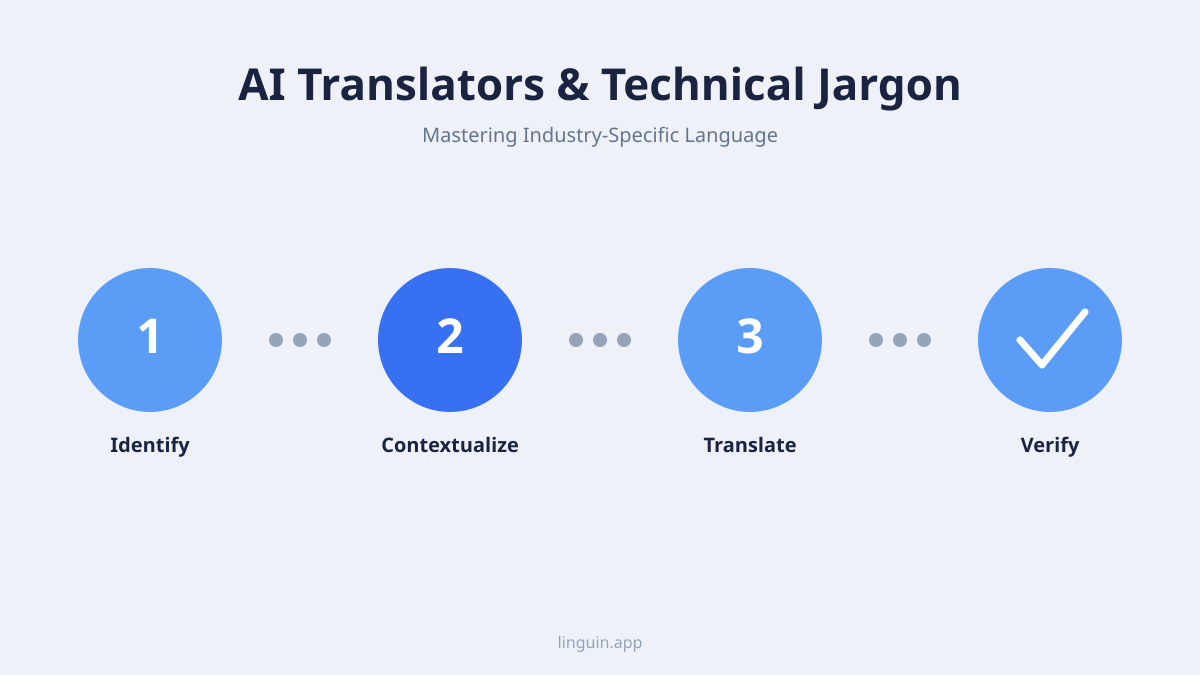
Say you’re messaging a colleague in Japan about a software bug. You write, “The issue is a race condition in the cache layer.” A basic translator might render “race condition” literally, resulting in confusion. A context-aware AI translator, recognizing the computing context from words like “cache” and “bug,” would produce the technically accurate Japanese term for a race condition, ensuring your colleague understands the critical programming error you’ve identified.
How modern AI models understand context
The leap from older statistical translation to modern neural AI translation is fundamentally about context. Early systems translated phrases in isolation. Today’s models, particularly large language models (LLMs) and specialized neural machine translation (NMT) engines, analyze entire sentences, paragraphs, and even full documents as a cohesive unit. This holistic view is what enables them to disambiguate technical terms.
The technology behind this is the transformer architecture. This design allows the model to weigh the importance of every word in a sentence in relation to every other word, regardless of distance. When it encounters a polysemous word like “port,” it can look at the nearby words. Is it “port number,” “serial port,” “Port 80,” or “shipping port”? The model calculates probabilities based on its training on millions of technical documents, scientific papers, and code repositories, determining that in a sentence about network configuration, “port” almost certainly refers to a logical construct, not a harbor. This deep contextual analysis is a cornerstone of achieving high ai translation accuracy.
Beyond the sentence, document-level context provides even more clues. The consistent use of certain terms throughout a user manual or a research paper establishes a domain. If the first few pages of a document repeatedly mention “plaintiff,” “jurisdiction,” and “liable,” the AI can confidently classify the text as legal and apply a corresponding translation style and lexicon for the remainder of the translation. This coherence is vital for maintaining consistent terminology across long projects, a topic explored in our guide on ai translation for multilingual project management.
This contextual understanding also extends to grammatical structures and collocations. Technical languages have predictable patterns. In engineering English, you often find “subject-verb-object” structures like “The valve regulates the flow.” A trained AI learns to produce a grammatically sound and stylistically appropriate equivalent in German or Chinese that a professional in that field would expect to read. It’s not just about translating words, it’s about translating meaning within a recognized framework.
The critical role of custom glossaries and terminology management
While AI models are powerful, they are not infallible dictionaries. For business-critical translations, you need control. This is where custom glossaries and terminology management become indispensable. A glossary is a predefined list of terms and their approved translations, which the AI translator is instructed to use consistently, overriding its default suggestions.
The primary use case is for brand and product names. A company must decide if its product name is transliterated, translated, or left in its original form. For example, a tool like Linguin would specify that its name is never translated but always appears as “Linguin” in all languages. Similarly, a term like “Linguin Pro” might be specified to remain unchanged. This ensures brand consistency globally.
More importantly for technical jargon, glossaries enforce precision for industry-specific terms. In the automotive industry, “turbocharger” and “supercharger” are distinct technologies. A company might mandate specific translations for each to prevent confusion in service manuals across different languages. In finance, the precise translation of terms like “derivative,” “amortization,” or “equity” is non-negotiable for legal compliance. By uploading a glossary, you train the AI on your organization’s specific language, turning it into a domain expert for your content.
Implementing this is straightforward with modern apps. You can create and manage glossaries within a platform, often supporting multiple languages and domains. When you initiate a translation, the system first checks the active glossary. If a source term matches, it uses the prescribed translation. This process is vital for app localization and software documentation, where UI strings and technical terms must be identical across all language versions. For a deeper look at adapting content for specific markets, consider reading about ai translation and cultural context in marketing.
This control addresses a key concern in the debate of ai vs human translation. While a human expert has internalized terminology, an AI can replicate that expertise at scale when guided by a well-maintained glossary, ensuring that every translation, from the first to the thousandth, adheres to the same standard.
Training on domain-specific data sets
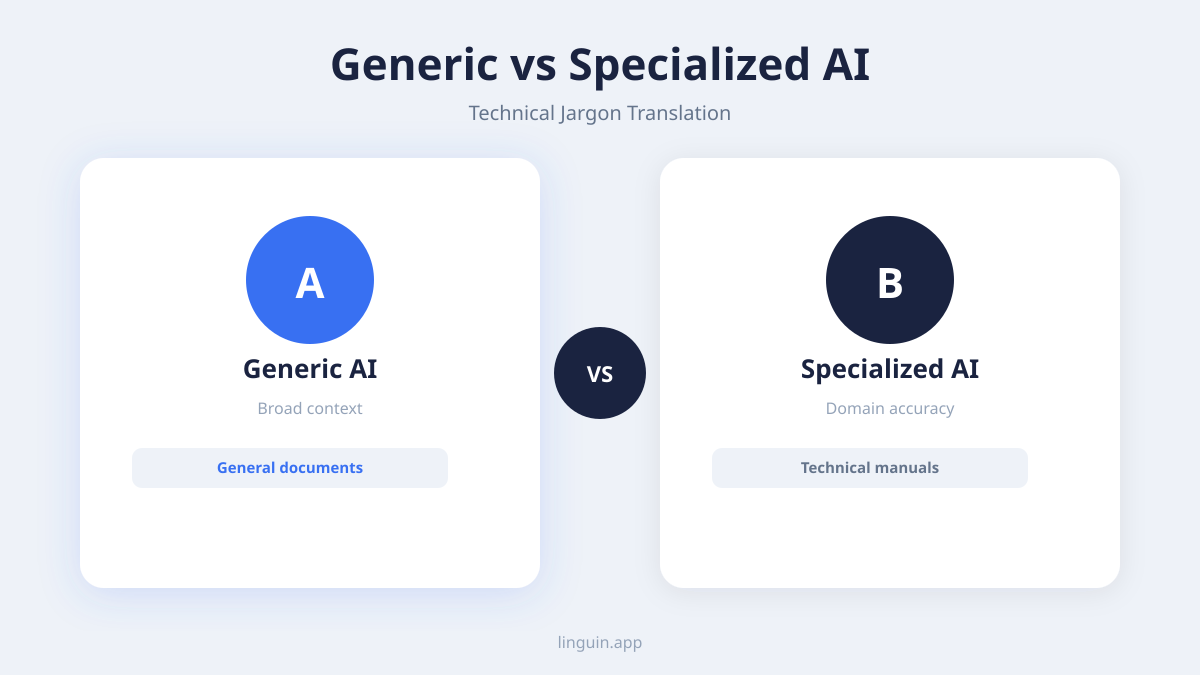
The raw capability of an AI model is shaped by what it has learned. General models are trained on vast, diverse corpora of internet text, which gives them broad linguistic knowledge. However, to excel with technical jargon, models require a diet of domain-specific data. This involves training or fine-tuning the AI on parallel texts-collections of documents that are exact translations of each other in the source and target languages-from specialized fields.
For legal AI translation, the model would be fed contracts, court rulings, patent filings, and legislation. From this, it learns the formulaic language, standard clauses, and precise terminology of the law. It understands that “force majeure” is a term of art often left untranslated, and that “joint and several liability” has a specific, complex meaning that must be rendered accurately.
In the medical and pharmaceutical domain, training data includes clinical trial reports, research papers, medical device manuals, and patient information leaflets. The AI learns to handle Latin-based anatomical terms, standardized drug names (using INN, or International Nonproprietary Names), and the careful, unambiguous language required for safety. It also learns to navigate stringent regulatory requirements for translated medical content.
The software and IT sector provides its own unique data, such as API documentation, source code comments, technical blog posts, and UI strings. Here, the AI learns to translate code-related terms like “function,” “loop,” and “string” correctly, and to handle the mix of formal explanation and conversational tutorial tone often found in developer docs. It also becomes adept at not translating proper nouns within code snippets. For those working in tech, using a dedicated ai translator for Mac that understands this context can streamline communication and documentation.
This specialized training allows the AI to develop an internal representation of the domain’s “sub-language.” The result is output that doesn’t just use the right words, but also “feels” right to a professional reader in that field, significantly boosting trust and usability.
Real-world application scenarios
Understanding the theory is one thing, seeing it in action is another. Let’s examine two concrete scenarios where AI translation of technical jargon makes a tangible difference.
Scenario 1: A German engineer needs to understand a Japanese manufacturing specification. The document is dense with material science terms, tolerance measurements (e.g., “±0.05 mm”), and specific process names like “carburizing.” A generic translator might stumble on compound German words or misinterpret the symbols. An AI tool like Linguin, attuned to engineering contexts, would correctly translate the technical processes, preserve the numerical precision, and format the units according to German conventions. It would understand that “S45C” refers to a specific steel grade and either leave it untranslated or add a clarifying note. This allows the engineer to proceed with procurement or production without delay or error.
Scenario 2: A multinational legal team is reviewing a merger agreement drafted in French. Key clauses covering “representations and warranties,” “indemnification,” and “governing law” must be perfectly clear in English. Using an AI translator with a legal glossary ensures that these terms of art are translated consistently with the firm’s past documents and jurisdictional standards. The AI can also handle the complex, nested sentence structures common in legal writing, producing an English draft that is coherent and usable for initial review, saving associates hours of preliminary work. This application is crucial for ai translation in remote multilingual teams.
These scenarios highlight that the goal is not always a perfect, publication-ready translation. Often, it’s about comprehension and acceleration. The AI provides a high-fidelity draft that experts can review and polish quickly, breaking down language barriers to collaboration and decision-making. This is especially powerful when combined with the convenience of tools like a best translation Chrome extension, allowing for instant translation of technical web pages or documents within the browser.
Limitations and the human-in-the-loop model
Despite impressive advances, AI translation of technical content has limitations that necessitate a human-in-the-loop approach. The most significant limitation is a lack of true conceptual understanding. An AI model identifies patterns and statistical relationships between words, but it does not “know” what a semiconductor is in the way a physicist does. It cannot reason about the underlying concepts if the text presents a novel analogy or explains a breakthrough technology in a way that deviates from its training data.
This can lead to errors with highly novel or proprietary terminology. If your company has invented a new process called “Quantum-Flux Annealing,” the AI has no prior reference. It might translate it literally, which could be meaningless or incorrect. A human expert is needed to define the term and decide on its translation, which can then be added to a custom glossary for future use.
Another area where humans are essential is quality assurance and post-editing. For any mission-critical document-a patent, a clinical study report, a financial audit-the final output must be certified by a subject-matter expert who is also a native speaker of the target language. This expert checks for nuances, ensures compliance with local regulations, and verifies that the translation is not only accurate but also idiomatic for the intended professional audience. The AI provides a superior first draft, but the human provides the final validation.
This collaborative model is the industry best practice. It leverages the speed, consistency, and scalability of AI while incorporating the critical thinking, cultural intelligence, and deep expertise of human professionals. It’s a synergy that delivers both efficiency and reliability.
The future of AI and specialized translation
The trajectory for AI translation in technical fields points toward even greater specialization and integration. We are moving toward the development of vertical-specific translation models. Instead of one general model for all topics, we may see pre-trained models specifically for biotechnology, civil engineering, or intellectual property law, available as selectable options within a translation platform. These would offer out-of-the-box higher accuracy for their niche.
Another key trend is deeper integration with knowledge graphs and databases. An AI translator could connect to a live medical database like MeSH (Medical Subject Headings) or a legal ontology to verify term definitions and relationships during translation. This would move it closer to true understanding, allowing it to make more informed decisions when context alone is ambiguous.
Furthermore, the process will become more interactive and adaptive. Future tools might engage in a dialogue with the user. If the AI encounters an ambiguous term, it could ask, “In this context, does ‘monitor’ refer to a display screen or a program that observes system activity?” The user’s clarification would then immediately improve the translation and could be logged to refine the model or glossary. This turns translation into a collaborative, iterative process.
These advancements will further blur the line between translation and knowledge management, making AI an indispensable partner for global enterprises, researchers, and professionals who work at the intersection of language and specialized knowledge. Staying updated on these trends is easier with resources that compare the best translation apps and their evolving capabilities.
Frequently asked questions
Can AI translators learn my company’s unique technical terms?
Yes, absolutely. This is achieved primarily through custom glossaries and terminology bases. You can create and upload a list of your proprietary terms, acronyms, and product names with their approved translations. When the AI translates your documents, it will consistently use these prescribed terms. Some advanced systems also allow for fine-tuning on your own translated document pairs, helping the model learn your specific writing style and domain language over time.
How accurate is AI with complex legal or medical documents?
For well-established terminology and standard document formats, modern AI translation can be highly accurate, often providing an excellent draft that requires only expert review (post-editing) rather than full retranslation. Its accuracy stems from training on large volumes of legal and medical parallel texts. However, for novel concepts, nuanced interpretations, or documents with serious legal or health implications, human expert review remains mandatory. The AI handles the bulk of the work, but the human ensures safety and precision.
What’s the difference between a technical AI translator and a regular one?
A regular translator is optimized for general, everyday language like news articles, emails, and websites. A technical AI translator has been specifically trained or fine-tuned on domain-specific data sets from fields like engineering, law, or medicine. This gives it a much stronger grasp of the precise terminology, stylistic conventions, and grammatical structures used in those fields. It’s the difference between a general practitioner and a specialist doctor.
How do I ensure consistency when translating a large technical manual?
The key tools are a comprehensive custom glossary and the use of translation memory features. First, build a glossary of all key terms in the manual. Use an AI translation platform that allows you to apply this glossary across the entire project. As you translate chapters, the system will store your translations in a memory, ensuring that if the same sentence or phrase appears again, it is translated identically. This combination enforces terminological and stylistic consistency from start to finish.
Leveraging AI for your technical translation needs
Successfully translating technical jargon requires the right combination of advanced technology and strategic human oversight. The core principles are clear: leverage AI’s contextual understanding to disambiguate terms, use custom glossaries to enforce precision on critical vocabulary, and always plan for expert human review for final validation. This approach gives you the speed and scale of automation without sacrificing the accuracy that specialized fields demand.
The most effective next step is to move from theory to practice with your own content. Start by identifying a segment of your technical documentation, an email thread with a foreign colleague, or a research abstract. Use a capable AI translation tool and create a small, focused glossary of your five most important terms. Observe how the translation changes when the glossary is applied. This hands-on test will demonstrate the tangible impact of terminology management.
Platforms like Linguin are built to support this workflow, integrating glossary management, context-aware AI models, and seamless operation across devices into a comprehensive ai language translation tool. By understanding and applying the methods outlined here, you can break down language barriers in your professional field with greater confidence and efficiency.