 English
  Español
  Français
  Deutsch
  Português
  Italiano
  Русский
  中文(简体)
  日本語
日本語  한국어
한국어  العربية
  हिन्दी
  Nederlands
  Türkçe
  Polski
How do AI translation tools handle conversations that fluidly mix two or more languages? This linguistic phenomenon, known as code-switching, is a common feature of multilingual communication and presents a unique challenge for translation technology. For global professionals, language learners, and anyone navigating multicultural spaces, understanding this process is key to effective digital communication. This article explains the mechanisms behind AI translation for code-switching, the challenges involved, and how modern tools are adapting to our multilingual reality.
Key takeaways
- AI translators use context-aware models to detect language boundaries within a single sentence or conversation.
- Successful handling of code-switching depends on understanding the speaker’s intent and the grammatical rules of each language involved.
- Tools like Linguin are designed to process mixed-language input and provide coherent, natural-sounding translations in a target language.
- The ability to manage code-switching is becoming a standard feature for professional and personal translation needs.
What is code-switching in language?
Code-switching is the practice of alternating between two or more languages or dialects within a single conversation, sentence, or even phrase. It is not a sign of confusion or a lack of proficiency. Instead, it is a sophisticated, rule-governed linguistic behavior. People code-switch for various reasons, such as expressing a concept that lacks a direct equivalent in one language, quoting someone, emphasizing a point, or signaling group identity and solidarity.
From a linguistic standpoint, code-switching follows specific grammatical patterns. It is not random. For instance, a speaker might switch languages at a clause boundary or insert a noun phrase from one language into a sentence structured by another. The switches are often seamless and meaningful to other bilingual speakers in the conversation. This fluidity is a natural part of the bilingual cognitive experience.
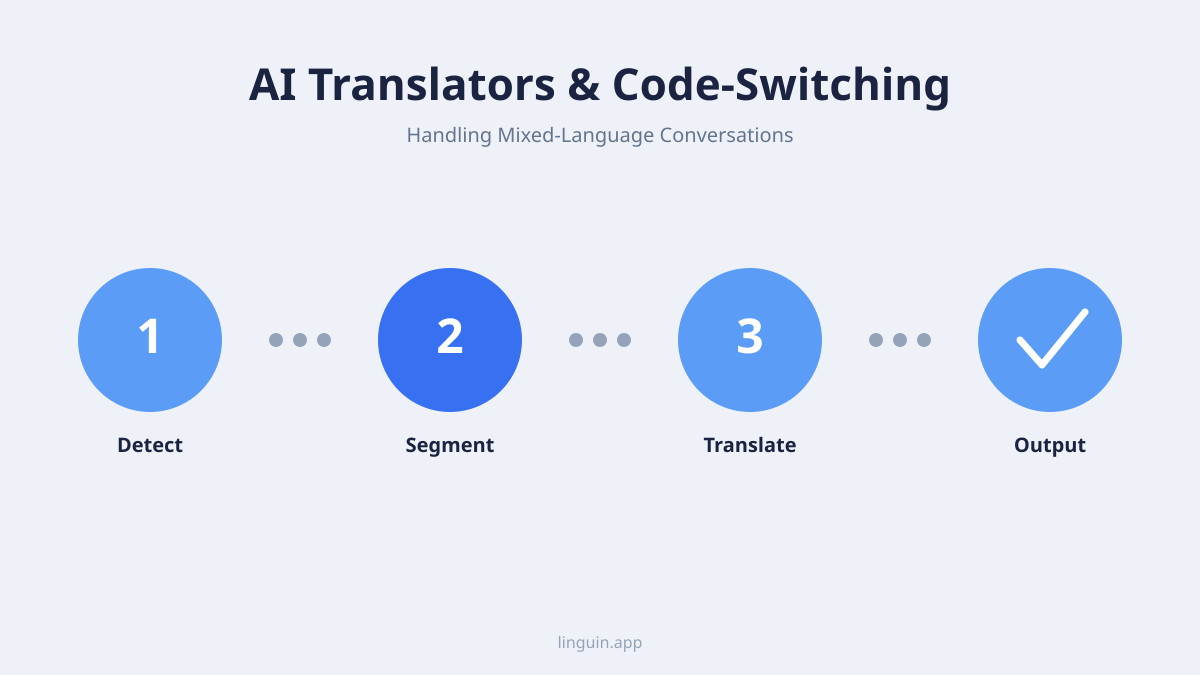
Understanding this is the first step in appreciating the translation challenge. A word-for-word substitution approach would fail completely, producing gibberish. The translator must first identify which parts belong to which language, then understand the meaning of each segment within its own linguistic system, and finally render a coherent message in a new target language. This requires a deep, contextual understanding that goes far beyond dictionary lookups.
How AI translation models detect language boundaries
For an AI translator to handle code-switched text, its first and most critical task is language identification. It must scan the input and accurately pinpoint where one language ends and another begins. Modern neural machine translation models are trained on massive datasets that include monolingual and multilingual text. Through this training, they learn statistical patterns, common character sequences, and syntactic structures unique to each language.
The process is contextual. The AI does not look at each word in isolation. It considers the surrounding words to make a judgment. For example, in the sentence “I need to buy leche from the store,” the model sees the English grammatical structure (“I need to buy… from the store”) and the Spanish noun “leche.” It uses the context to classify “leche” as Spanish and the rest as English. More advanced models can handle intra-sentence switches that are grammatically integrated, like “She is my meilleure amie,” where a French adjective-noun phrase is embedded within an English sentence.
This detection is powered by subword tokenization, a common technique in models like those based on the Transformer architecture. Words are broken down into smaller units, or tokens, which helps the model manage vocabulary from multiple languages efficiently. When it encounters a token, it assesses the probability of it belonging to a particular language based on the sequence it appears in. The model’s attention mechanism then weighs the importance of different parts of the sentence, allowing it to maintain coherence across language switches. This foundational step of accurate detection is what enables all subsequent translation work.
The challenge of context and intent in mixed-language input
Once languages are identified, the real work of translation begins. The core difficulty with code-switched content is that meaning is often layered and dependent on cultural and conversational context. A simple phrase like “Vamos a faire du shopping” blends Spanish and French. A direct, disjointed translation might be “Let’s go to do of the shopping,” which is nonsensical. The AI must infer the unified intent, “Let’s go shopping,” and produce a natural phrase in the target language.
The intent behind a switch is crucial for an accurate translation. A speaker might switch to another language to use a term of endearment, a technical jargon, or a culturally specific concept. For instance, in a business chat, someone might write, “The Q3 report shows strong growth, pero tenemos que discutir los riesgos.” The switch to Spanish signals a shift in focus, perhaps to a more sensitive or detailed topic. An adept AI translator should preserve that subtle shift in tone and emphasis in the output, not just translate the words. It must understand that the speaker is connecting two related but distinct ideas.
This requires models that have been trained not just on parallel text, but on understanding pragmatics, the study of how context influences meaning. The AI must answer questions like: Why did the speaker switch here? Is this a loanword, a quote, or an emotional emphasis? Without grasping this intent, the translation can be technically correct but contextually tone-deaf. This is where the latest generation of large language models (LLMs) shows significant promise, as they develop a better sense of discourse and speaker goals from their vast training corpora. For more on how AI handles nuanced intent, see our article on AI translation for formal and informal tone in emails.
Real-world scenarios for AI translation of code-switching
To see the practical value of this technology, consider a few common situations where it is essential.
Scenario 1: Multilingual Customer Support A customer writes a support ticket: “My order #45021 hasn’t arrived. Il était supposé être livré hier. Can you check the status?” This message mixes English and French. A support agent who only speaks English needs a full translation to understand the problem. An AI tool that handles code-switching can translate the entire query cohesively to: “My order #45021 hasn’t arrived. It was supposed to be delivered yesterday. Can you check the status?” This allows for a swift and accurate response, improving customer satisfaction. For businesses, this capability is integral to effective multilingual customer support.
Scenario 2: Academic Collaboration and Research Researchers from different linguistic backgrounds often collaborate. In an email chain, a German scientist might write: “The data from the neue Experimente strongly supports our hypothesis, but we need to replicate it.” The term “neue Experimente” (new experiments) might be used because the experiments are a defined concept in their shared work. A good AI translation would recognize this as a key term and handle it appropriately, perhaps even leaving it untranslated if that is the convention, or translating it smoothly within the sentence. This preserves the precise academic meaning.
Scenario 3: Social Media and Informal Messaging This is where code-switching is most frequent and creative. A user might post: “Just had the best tacos al pastor! #foodie #blessed.” The AI translator, perhaps used by a friend or follower who doesn’t speak Spanish, needs to translate “tacos al pastor” as a coherent food item, not as separate words. It might result in “Just had the best shepherd-style tacos!” or simply “al pastor tacos,” depending on the desired output fluency. The ability to handle these casual, blended expressions is key for social connectivity and content understanding across borders.
The role of training data and AI model design
The performance of an AI translator in code-switching scenarios is directly tied to the data it was trained on and the architecture of its model. If a model is only trained on clean, parallel corpora of single-language sentences, it will be baffled by mixed-language input. Therefore, developers must intentionally include code-switched data in the training process.
This data can come from various sources. Social media platforms, online forums, and transcribed bilingual conversations are rich with natural code-switching examples. By training on this data, models learn the common patterns, frequencies, and grammatical structures of switches between specific language pairs, such as Spanglish (Spanish-English), Hinglish (Hindi-English), or Singlish (Singaporean English). The model learns that certain switches are more probable than others.
Model design also plays a major role. Models that use a single, massively multilingual neural network, as opposed to many separate bilingual models, have an advantage. In a unified model, representations for all languages exist in a shared space. This allows the model to draw connections and transfer knowledge between languages more effectively. When it encounters a mixed sentence, it can activate the relevant pathways for each language component simultaneously and generate a coherent output. Furthermore, techniques like transfer learning, where a model pre-trained on a huge amount of general text is fine-tuned on specific code-switching tasks, greatly enhance performance. This approach is central to creating tools that are both versatile and accurate.
Limitations and the path forward for AI translators
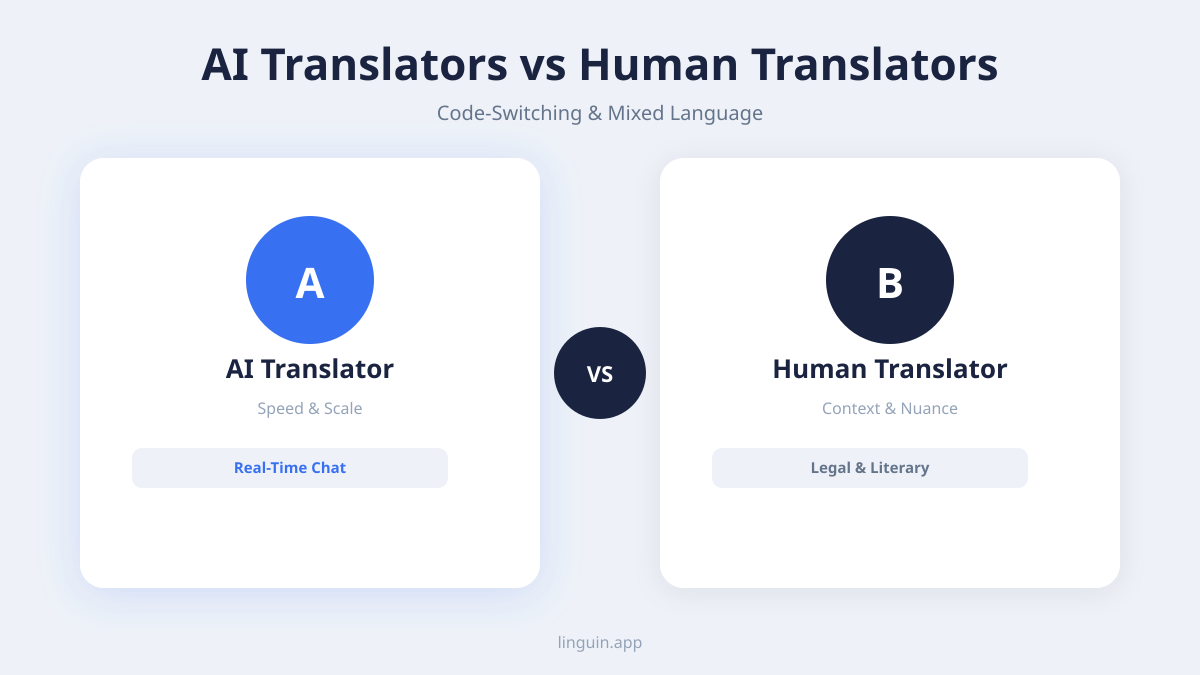
Despite impressive advances, AI translation for code-switching is not a solved problem. There are clear limitations. Performance can vary significantly based on the language pair. Switches between widely spoken languages with ample training data are handled better than those involving less-resourced languages. The AI may also struggle with very rapid, unpredictable switching or with highly idiomatic expressions from one language inserted into another.
Another challenge is preserving the stylistic and social function of the switch. Sometimes, the switch itself is the message, conveying identity, humor, or exclusion. A perfect semantic translation that erases the switch might lose that layer of meaning entirely. The AI might translate a mixed sentence into a fluent single-language sentence, but the cultural nuance is gone. Developers are now exploring ways to not only translate the content but also annotate or explain the presence of a code-switch when appropriate for the context.
The path forward involves more sophisticated, context-heavy models and richer, more diverse training datasets. The goal is to move from mere translation to true linguistic interpretation. This means AI that can understand when a code-switch is a deliberate rhetorical device and reflect that in the output. It also means building tools that are accessible and reliable for everyday users, whether they are managing remote multilingual teams or simply chatting with friends abroad. As these models improve, they will become better at navigating the complex landscape of regional dialects and business communication.
How Linguin approaches mixed-language translation
Linguin is built to navigate the complexities of modern, multilingual communication. The app’s underlying AI models are designed with the reality of code-switching in mind. When you input text that blends languages, Linguin first performs a real-time analysis to segment the text by language. It then processes each segment according to its linguistic rules while maintaining the overall coherence and flow of the message.
The focus is on producing a natural-sounding translation in your chosen target language. Whether you are pasting text from a multilingual chat, translating a webpage with loanwords, or speaking in a conversation that dips in and out of your native tongue, Linguin works to provide a clear and accurate result. This functionality is integrated across the macOS, iOS, and browser extension platforms, making it a seamless part of your digital workflow. It complements other advanced features designed for nuanced translation, such as handling cultural context in marketing or preserving the meaning of untranslatable words and concepts.
The development of this capability is ongoing. By leveraging state-of-the-art language models and continuous learning from diverse linguistic data, Linguin aims to reduce the friction in understanding and being understood, no matter how many languages are in play. It is part of a broader commitment to creating translation tools that are as dynamic and adaptable as human language itself.
Frequently asked questions
Can AI translators accurately translate slang and informal code-switching?
Yes, modern AI translators are increasingly capable of handling slang and informal language mixed into conversations. Their performance depends on the quality and recency of their training data. Models trained on contemporary sources like social media, forums, and messaging apps are exposed to casual, code-switched language. This allows them to learn current slang terms and informal expressions, translating them into appropriate equivalents in the target language. However, very new or hyper-local slang may still pose a challenge until it becomes widely represented in training datasets.
What happens if the AI misidentifies the language of a word?
Language misidentification is a possible error, especially with short words or homographs that exist in multiple languages. If this occurs, the translation for that segment will be incorrect, which can distort the meaning of the entire sentence. To mitigate this, advanced AI models use strong contextual clues. They look at the surrounding sentence structure and the probability of word sequences to make a more informed guess. The overall accuracy of this process is high for common language pairs, but users should review critical translations for potential errors.
Is it better to manually separate languages before translating?
While you can separate languages manually to ensure clarity, it defeats the purpose of seamless, real-world communication. The strength of a capable AI translator is its ability to handle mixed input automatically, saving you time and effort. For quick, informal translations, relying on the AI’s detection is efficient and usually accurate. For highly important or complex documents where perfect accuracy is essential, pre-segmenting the text could be an extra precautionary step, but it should not be necessary for well-designed tools.
How does this technology help language learners?
For language learners, observing and understanding code-switching is a valuable part of acquiring natural fluency. AI translators that handle code-switching can serve as a comprehension aid. A learner reading a bilingual forum or watching a video where speakers switch can use the tool to get a coherent translation, helping them grasp how native speakers blend languages in practice. It can also help learners produce more natural sentences when they wish to incorporate a well-known loanword or phrase from their target language into their native language output.
Embracing fluid translation for a connected world
The ability to translate code-switched conversations is more than a technical feature. It is a necessary evolution for translation technology in our interconnected world. As multilingual interactions become the norm in digital spaces, from work chats to social media, tools must adapt to the fluid way people actually communicate. The core principles remain accurate language detection, deep contextual understanding, and the generation of natural output.
The next step is to experience this capability in your own workflow. Whether you are collaborating with international colleagues, consuming global media, or connecting with friends and family, mixed-language text is likely already on your screen. Trying a translation tool designed for this reality can transform those interactions from confusing to clear.
Linguin integrates this sophisticated approach to translation directly into your browser and desktop, allowing you to understand and participate in conversations as they naturally happen. You can explore its features for handling not just code-switching but a wide range of complex translation needs, contributing to smoother and more effective cross-language communication every day.